Class 9 Diversity in living organisms Sample Paper Question Answers


 Class 9 Diversity in living organisms Sample Paper Question Answers


1.(i) State reasons why Echidna and platypus lay eggs but are considered as mammals.

Ans.They have mammary glands for the production of milk to nourish their young ones.

(ii) Forelimbs of birds are modified

Ans.To reduce body weight for flight.

Why Do We Fall ILL Important Questions Worksheet

CBSE Class 9 Why Do We Fall ILL Important Questions Worksheet


1.In a school assembly, the students were asked to we ar full sleeves shirts, full pants and socks pulled till knees, use mosquitoes repellants cream during day time.
(i) Name the disease, about which preventive instru ction are given in the assembly.
(ii) Name the vector of this disease.
(iii) Give two preventive environmental measures.
(iv) Which two values were given in assembly relate d to society?

CLass 7 Waste Water Story NCERT Solutions

1. Fill in the blanks:
(a) Cleaning of water is process of removing contaminants .
(b) Wastewater released by houses is called sewage .
(c) Dried dung is used as manure.
(d) Drains get blocked by plastic and sludge .

Carbon and its compounds Important Questions and Answers

CBSE Class 10 Important Question and Answers of Carbon and Its compounds Sample paper 2017


1.A salt X is formed and a gas is evolved when ethanoi c acid reacts with sodium hydrogen carbonate. Name the salt X and the gas evolved. D escribe an activity and draw the diagram of the apparatus to prove that the evo lved gas is the one which you have named. Also, write chemical equation of the reaction involved.

CBSE Class 9 Science SA 2 Sample paper 2017

1. Name the Indian philosopher who proposed the theory of matter.

2. What is Dalton?

3. Define 1 watt of power.

4. Will advanced organisms be the same as complex orga nisms? Why?

5. Why are sound waves called mechanical waves?

6. List any three human activities which would lead to an increase in the carbon dioxide content of air.

CBSE Class IX Science Sample paper SA 2 2017

1. What are polyatomic ions?

2. What is meant by the term chemical formula?

3. State the law of conservation of energy.

4. How would you choose between two characteristics to be used for developing a hierarchy in classification?

CBSE Class 9 Science SA 2 Sample paper 2017

1. Give one word for the following:

(i) Positively charged ion

(ii) A group of atoms carrying a charge

Diversity in Living Organisms Class 9 Solutions

Important question and answers of diversity in living organisms Class 9

CBSE Class 9 Science Biology Diversity in living organisms question and answers

1.In what respects are lichens unusual plants?
Ans. lichen is a close partnership between an alga and a fungus. The algal cells grow in the fungal mycelium. Alga make food by photosynt hesis. The fungus provides shelter and protection to the alga. Thus, both the alga and the fungus benefit. This kind of association is called a symbiotic asso ciation.

2.Na me two coelenterates with diagrams. How do porifera n animals differ from coelenterate animals?
Ans.Examples of coelenterates. Poriferans are the simplest multicellular and branched. The cells are loosely held together and do not form tissue Coelenterates have one continuous central cavity called coelentron.

Electric Current and Its Effects Class 7 CBSE Science

 Important Notes of Magnetic Effects of Electric Current
Electric Current:
Flow of electrons through a conductor. 
•It is convenient to represent electric components by symbols. Using these, an electric circuitcan be represented by a circuit diagram. 

Heredity and Evolution Class X Important Question and Answers

Science class 10 Heridity and Evolution

1.Why acquired characters are not inherited?
Ans.Acquired traits are those which are dev eloped in the organisms during their life time. They are not inherited to next generations. These traits are because of non- reproductive tissues, so cannot be passed.

2.How is the chromosome number restor ed in zygote?

Ans.Gametes (male and female) have N number o f chromosomes. During fertilization gametes fuse and forms zygote. Zygote retains 2N nu mber of chromosomes.

3.What are variations? Give their types.
Ans.Although offspring of the same parents re semble one another as to their parents, yet three are differences among them. These differe nces are called variations. It is of two types- (a) Reproductive- Passed from one generation to another . (b) None reproductive- Not passed from one generation t o another.


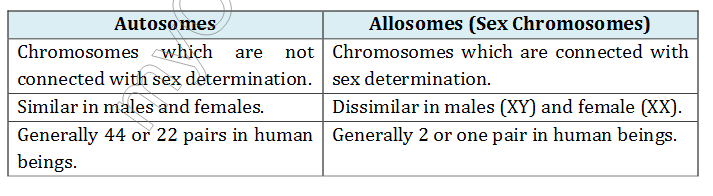
4.Write difference between Autosomes or Allosomes.
Ans.

5.State the evolutionary force which leads to origin of a new species.
Ans. Various elemental forces of evolution are- (a) Mutation (b) Recombination (Crossing over during meiosis, Random assortment of gene at the time of gamete formation). (c) Natural selection or survival of the fittest. (d) Genetic drift
6.What is a fossil? How do fossils tells us about the process of evolutions?
Ans. The dead remains of former living organ isms are called fossils. The branch of biology which deals with the study of fossils is ca lled paleontology. The study of fossils tells us that species arose from previously existing ones or that the evolution has occurred in nature and is still conti nuing.

7.Who disproved Lamarckism and how?
Ans. The concept of inheritance of acquired character of Lamark was disproved by August Weismann. He cuts the tail of rat at the tim e of birth and continued this for 21 generation. But tailless rats were never bor n. This trait do not change the DNA of germ cells so cannot be inherited. Hence, th e changes in non-reproductive tissue of an individual during its lifetime cannot be passed on to its progeny, and cannot direct evolution.

8.Give the basic features of the mechanism of inheritance.
Ans. Basic features of mechanism of inherit ance- (a) Each character is controlled by a pair of factors. The factors may be similar or dissimilar. (b) When two dissimilar factors of a character are pres ent in an organism, only one expresses itself while other remains unexpresse d. (c) Two factors of a character are separated at the tim e of gamete formation and get only one factor for that character. (d) Inheritance of two or more pairs of contrasting tra its in such a way that one pair of contrasting traits is independent of the ot her pairs of contrasting traits.
9.Give difference between diploid and haploid

Ans.

10.Mention two sources of variation.
Ans. (1) Errors in DNA copying.
(2) Random fertilization.

11.What is monohybrid and dihybrid cross?
Ans. Monohybrid cross- It is the simplest cross in which inheritance of one character is studied. A cross is made between the pair of pla nts having one contrasting character such as tall or dwarf.
Dihybrid cross- A cross made be tween two plants having two pairs of contrasting character is called dihybrid cross. For ex. round a nd green seed crossed with yellow and wrinkled seed.

11.Why did Mendel choose pea plant for his experimentation?
Ans.Mendel selected garden pea for his ex periment for the following reasons- (a) The life span of this plant is very short so result s can be obtained and studied faster. (b) Garden pea has many characteristics which are in co ntrast to each other. (c) Moreover this plant is small, easy to grow and repr oduce large number of offsprings.

12.How does Archaeopteryx provide evidence for organic evolution?
Ans. Archeoptyrx has some features of repti les, characters of dinosaurs as well as some features of birds like wings. This shows that birds are closely related to reptiles. Birds could evolve from reptiles.

13.What is divergent evolution? Explain with the help of example
Ans. The formation of dissimilar looking or ganisms from common ancestors is called divergent evolution. This is also known as adaptive radiation which represents evolution of new forms in several directions from t he common ancestors type. The current example of such a process is the evolut ion of wild cabbage. For over more than 200 years, humans have cultivated wild ca bbage as a food plant and generated different vegetables (like cabbage, brocc oli, cauliflower, kohlrabi and kale etc) from it by different artificial selection s. Thus all these structures of different vegetables are descended from the same an cestor i.e. wild cabbage.
14.What is the difference between reproductive and non - reproductive variations ?
Ans.

15.Write similarities between Mendalian’s factors and gene.
Ans. Mendel proposed the inheritance of trait s from parents to offsprings by hereditary units called factors. Mendel suggested t hat every character is controlled by a pair of factors. Sutton and Boveri (1902) found striking similarities between the behaviours of Mendelian fa ctors and the chromosomes during meiosis and fertilization. Factor and chromo somes are present in paired condition in the parents, seprate during meiosis an d again get paired after fertilization.

16.What is emasculation? Why is it done?
Ans. Removal of anther to avoid pollination in experimental plant is called Emasculation.

17.What is gene? Where are genes located?
Ans.Segments of DNA are called gene. Genes are located on chromosomes.

18.How many contrasting characins did Mendel see in garden pea? Give any two of them.
Ans. Mendel observed seven contrasting charact ers is pea plant. For Ex- flower position- axial an d terminal. seed shape- round and wrinkled.

19.Give difference between homologous and analogous or gans.
Ans.

20.State three law s of Mendel.
Ans. Mendel’s law- (A) Law of dominance- when two dissimilar factors of a character are present in an organism only one expresses itself (dominant fac tor) while other remain unexpressed (recessive factor)
(B) Principle of segregation – two factors of a charact er are separated at the time of gamete formation and each gamete gets only one f actor for that character.
(C) Principle of independent assortment- this principle states that inheritance of two or more pair of contrasting traits is such a w ay that one pair of contrasting traits is independent of the other pair of contrasting traits.

21.Describe how the sex of the offspring is determined is the zygote is human beings?
Ans.The males can produce two types of game tes, either X-type or Y-type. The females produce only one type of gametes or ova, X-type. If X-type sperm fuses with the ovum, then the sex of the baby will be female. If Y -type sperm uses with the ovum, then the sex of the baby will be male. Sex of the b aby is decided at the time. Sex of the baby is decided at the time of fertilization.

22.Give a suitable explanation for “geographical isol ation of individual of a species lead to formation of a new species?
Ans. Reproduction barrier such as river (geogr aphical is olation) between the sub population leading to: a) Genetic drift or random changes in the gene frequen cy by chance alone e.g. selection of red or blue beetles instead of green i n presence of crows. b) Natural selection or selection of the fittest by na ture itself eg. Selection of green beetles instead of red ones in the presence o f crows.

23.( i ) Who provided the evidence of DNA as genetic materia l?
(ii) Why DNA is called polynucleotide. (iii) List three important features of double helic al model of DNA.
Ans.
(a) Mendel.
(b) DNA is made up many units o f nucleotides. (c) Important features- (1) Both the chains in helical runs anti-parallel.
 (2) There two nitrogenous base Purine (A, G) and pyrimidine (T, C).
 (3) A always bind with T an d C always binds with G.

24.Why acquired traits are not inherited?
Ans. Acquired traits are those which are devel oped in the organisms during their life time. These traits are because of non-reproductive tissue, so cannot be passed.

25.How evolution and classification are linked?
Ans. Classification is the arrangement of organi sms into groups on the basis of their characteristics. Characteristics are details of app earance or behaviour. Classification based on evolution is considered the most advanced and effective. The classification of organisms/ species into groups is a reflection o f their common ancestors and hence evolutionary relationship also.

26.What are coacervates?
Ans. First life molecules which are formed due to formation of membrane around amino acids, sugars and nitrogenous bases aggregates are called coacervates. Further development in coacervates leads to origin of life.

27.How do the two factors for a character, present in diploid cells, behave at the time gamete formation?

Ans. Two factors called X and Y, segregate durin g gamete formation. Hence gamete is either X or Y.
28.Only variations that confer an advantage to an indi vidual organism will survive in a population. Do you agree with this statement? Why or why not?

Ans.Variations that confer an advantage to an individual organism may or may not survive in the population depending upon the social behaviour of the organism. A variation in a social animal like ant may not survi ve in a population while a variation in an animal like a leopard may survive.

29.What are the different approach es to determine evolutionary history of man?
Ans. To construct evolutionary history of man , there are three approaches- (1) Historical method- It gives direct evidence in the form of fossil records. The age of fossils can be determined by carbon dati ng methods.
(2) Comparative method- By comparing several exis ting forms, we can makes ideas about their common ancestors and reconstruct their about possible history.
(3) Analytic method- By observing present day human be ing vestigial organs and by studying the development pattern from embryo to adult.

30.What is fossilization? How are fossils formed?
Ans.The process of fossils formation is calle d fossilization. Fossils are formed when organisms die; their bodies get decomposed and lost . Sometimes the body or a part of it may be in such an environment that it does no t let it decompose completely. The mud will eventually harden and retain the impre ssion of the body parts of the organism. This mud with the impression will be call ed fossil of the organism.

31.What are homo lo gous and analogous organ? Explain with the help of example.
Ans.Homologous organs are those which have si milar basic structure and origin but may have different functions. For example- Hands of human bein gs and wings of birds. Analogous organs- Organs which ha ve different basic structure and origin but have similar function are called analogous organs. For example- (1) wing of bat an d wing of bird. (2) wing of birds and wing of insect.

32.Give the pair of contrasting traits of the followin g characters in plant and mention which one is recessive and which is dominan t? (a) yellow seed (b) round seed

Ans. (a) Green seed- Dominant Yellow seed- Recessive (b) Wrinkled seed – Recessive Round seed- Dominant

33.Mention two important features of fossils which hel p in evolution.
Ans. (a) Fossils provide direct evidence o f evolution
 (b) Fossil records also provid e missing links between two groups of organisms, for example- Archaeopteryx.

34.What do you understand by the term natural selection?
Ans. According to theory of Natural selectio n, Nature select fittest animal for animal those who not fit, are eliminated by nature itself

35.Differentiate between convergent and divergent evol ution.
Ans.

36.What are the different ways in which individuals wi th a particular trait may increase in a population?
Ans.The factors which are responsible for rai sing a new species are selection of environmental conditions for survival of a particul ar species. If a variation occurs in a population and that variation results in bette r survival of the organism in the prevailing natural conditions, then the trait would be selected naturally and more in the population.

37.What are the different theories about origin of life?
Ans.(a) Theory of special creation- According to this theory the almighty god created life. (b) Theory of spontaneous generatio n- According to this theory, life originated from non-living materials by the process of a bioge nesis wring mud, decomposing matter, sun, air and water, etc. (c) Cosmozoic theory- It states tha t life came to Earth from some heavenly bodies in the form of spores or seeds. (d) Biogenesis- This theory states that life originated from pre-existing life. (e) Modern theory of origin of life - According to this, complex organic molecule was formed from simple inorganic molecules only in suitable condition.

38.What is the difference between chemical evolution and organic evolution?
Ans.

How Do We Reproduce CBSE Class X

Important Notes of How do We Reproduce

Reproduction is the process by which living organisms produce new
individuals similar to themselves.
– Reproduction ensured continuity of life on earth.
– Reproduction - A bridge to hereditary transmission.
– It involves continuation of characters from the parents to daughter cells by
Copying of DNA (Deoxyribose Nucleic Acid) molecules present in the
chromosomes of the cell.
– Copying of DNAs is also not a foolproof exercise, even minute changes bring
about Variation in the blue print of the offsprings.
– The useful variations are retained while the harmful one does not go beyond.
– Actually variations help the species to withstand drastic environmental
changes, thus save the species from becoming extinct and promotes its
survival for a longer time.
– This inbuilt tendency of variation is the "fuel" for Evolution.


– Asexual Reproduction is extremely useful as a mean of rapid multiplication.
It is common in lower plants and animals.
– Different form of Asexual Reproduction.

1. FISSION : the parent cell divides/splits into two daughter cell-Binary
Fission; splits into many cells-multiple Fission


2. BUDDING : A new organism is produced as an outgrowth of the parent
body part.


3. Spore Formation : Spores are
small, bulb like structure develops
at the top of the erect hyphae of the
fungus plant, released into the air
and ge rmina t e , into new
individuals after landing into food
or soil.


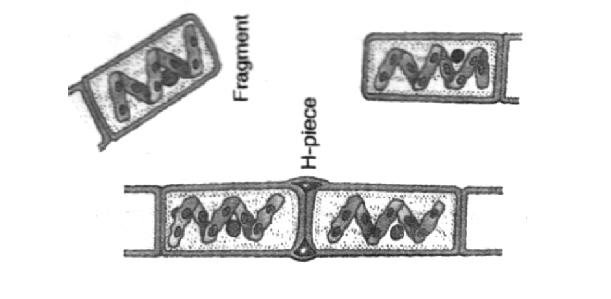
4. FRAGMENTATION : It is the accidental process when the broken pieces
of an organism (fragments) grows into a complete organism.

eg. fragmentation in
spirogyra


5. REGENERATION : When the simple animals like Hydra Planaria
develop a new individual from their broken older part it is known as
regeneration. It is carried out by specialised cells which grow large numbers
of cells.


VEGETATIVE PROPAGATION :
A mode of reproduction in which part like the stem, root, leaves develop into new
plant under favourable conditions.
Benefits
1. Plants can bear flowers, fruits earlier than those produced from seeds.
2. Growing Banana, orange, rose, jasmine that have lost the capacity to produce
seeds.
3. Genetical similarity is maintained in the plants.
eg. Sugarcane, rose, grapes by layering or grafting.


SEXUAL REPRODUCTION
When reproduction takes place as a result of fusion between two gamets, one from
each parent, it is called sexual reproduction.
– This process of fusion between two gamets is called fertilization.
– The formation of gamets involves exchange of chromosomal (genetic)
fragments between homologous chromosomes causing genetic
recombination which leads to variation.
SEXUAL REPRODUCTION IN PLANTS
It occurs mostly in flowering plants. In fact flowers are the reproductive organ of
plants.


A typical flower consists of four main whorls namely calyx (sepals), Corolla
(Petals), Androecium (Stamens) and Gynoecium (Carpels).


– Pollen grains of a flower transfer to stigma of the carpel of the same flower
(Self-Pollination) or to the carpel of the another flower (Cross-Pollination).
– This transfer of pollens is achieved by agent like wind, water or animals.
– After Pollination, the pollen grains reach to the egg cell in the form of a pollen
tube.

Fertilization : The fusion between the pollen grain and female egg cell. It
occurs inside the ovary. Zygote is produced in this process.


– Zygote divides several times to form an embryo within the ovule. The ovule
develops a tough coat and is converted into a seed.

– Ovary grows rapidly and ripens to forms a fruit, while the seed contains the
future plant or embryo which develops into a seedling under suitable
condition. This process is known as Germination.

REPRODUCTION IN HUMAN BEINGS
– Humans use a Sexual Mode of reproduction.
– It needs sexual maturation which includes creation of the germ cells ie, egg
(ova) in the female and sperm in the male partener & this period of sexual
maturation is called Puberty.
– Human beings have a well developed male and female reproductive system.
– The formation of male germ cell (sperms) takes place in the testes (male
reproducture organ)
– Actually a pair of testes are located inside scrotum situated outside the
abdominal cavity. It is meant to keep relatively a low temperature needed for
the production of sperms by testes.
– Moreover testes release a male sex hormone called testosterone whose
function is to:

1. Regulate the production of sperm
2. Brings about changes in appearance seen in boys at the time of puberty
The sperms along with the secretion of prostate gland and seminal vesicle,
together constitute semen, which is released and made to enter into the female
genital tract during Copulation.

The female germ cells or eggs are made in the ovaries, a pair of which is
located in both side of abdomen.

When a girl is born, the ovaries already contain thousands of immature
eggs.

At the puberty, some of these Eggs start maturing. One egg is produced every
month by one of the ovaries.
The Egg is carried from the ovary to the womb through a fallopian tube. These
two fallopian tube unite into an elastic bag like structure known as Uterus.

The Uterus opens into the vagina through the cervix.

Fertilization occurs in the fallopian tube of female genital tract.

The fertilized egg also called zygote (2n) gets implanted in the lining of the
Uterus, and start dividing. Actually uterus is richly supplied with blood to
nourish the growing embryo. If zygote is not formed, the inner wall of uterus
breaks which causes bleeding through vagina. This process is called
MENSTRUATION. It occurs at a regular interval of 28 days.

The Embroyo gets nutrition from the mother's blood with the help of a special
tissue called PLACENTA. It provides a large surface area for glucose and
oxygen to pass from the mother to the embryo. Similarly the wastes from
developing embryo are removed to mother's blood through placenta.

The child is born as a result of rhythmic contractions of the muscles in the
uterus. after Nine months (36 weeks) of development inside mother's womb.
It is also called Gestation Period.

The sexual cycle in a woman continues upto the age of 45 to 50 years. After
that the ovary do not release egg. This stage is called Menopause. It a also
marks the end of menstruation in the woman.


LIGHT-REFLECTION & REFRACTION CBSE Class X

Important Notes of LIGHT-REFLECTION & REFRACTION 

Light is a form of energy, which enable us to see the object.
In this chapter we will study the phenomena of reflection and refraction using the
property of light i.e. straight line propagation (Light wave travel from one point to
another, along a straight line).

Science Sample Paper Class 9 2016

Here are latest sample papers for Science Class 9 CBSE 2016 with Detailed solutions.Visit the following links to download the sample papers

CBSE Science Class 9 SAMPLE PAPER 2016 – 1 (Solved)

CBSE Science Class 9 SAMPLE PAPER 2016 – 2 (Solved)

CBSE Science Class 9 SAMPLE PAPER 2016 – 3 (Solved) 

 CBSE Science Class 9 SAMPLE PAPER 2016 – 4(Solved)

Coal and Petroleum CBSE Class 8 Important Question and Answers

State whether the following statements are true or false :-
a. The percentage of carbon is more in coke than in coal.
b. Petroleum is soluble in water.
c. Petroleum is an exhaustible or non renewable energy source.
d. Ammoniacal liquor is formed by solution of ammonia in oil.
e. Natural gas is a domestic and industrial fuel with high calorific value.
Ans.true, false, true, false, true .
2.What are petrochemicals? Explain.
Ans.Many useful products are obtained from petroleum and natural gas. They are called
petrochemicals.
These petrochemicals are the raw materials for the manufacture of the synthetic fibres
(nylon, acrylic, polyester etc) and detergents and many other useful polymers. Natural
gas yields which is used in the manufacture of ammonia which is further employed as
a raw material in the manufacture of fertilisers like urea.

Chemical Effects of Electric Current CBSE Class 8 Important Questions

 Class–VIII Science (Chemical Effects of Electric Current

Q.1Fill in the blanks
a. Electrolysis is used for ______ one metal over another metal.
b. A combination of cells is known as ______ .
c. In liquid the moving charges are called ______ .
d. The driving force that carries charges around a circuit is ______ force.
e. Electric current is the flow of negatively charged particles called ______

Ans.electroplating, battery, ions, electromotive, electrons.
Q2.Fill in the blanks :-
a. An electric current can bring about a ______ change.
b. An ______ when dissolved in water, breaks up into ions.
c. ______ are materials that allow electricity to flow through them.
d. ______ are also called as insulators.
e. A source of electricity is called a ______ .
Ans.chemical, electrolyte, conductors, non- conductors, cell.

Q2. What is the actual direction of electric current?
Ans.Electrons flow from an electron rich body/object to an electron deficit one. In other
words from a body that is negatively charged to a body that is positively charged.
However, scientists from earlier days thought that electric current is the flow of
positive charge from a positively charged body to a negatively charged body.
Therefore, they took this as the direction of flow of current.
Today, we consider the flow of conventional electric current to be from positive to
negative electrode

3. Why is it dangerous to handle electrical appliances with wet hands or while standing
on a wet floor ?
Ans.Small amounts of mineral salts are present naturally in water. They are beneficial for
human health. However, these salts make water conducting as such if we touch an
electrical appliance with wet hands or while standing on a wet floor, current will flow
through our body and result will be an electric shock.

4.Define electrolysis. Through diagram represent movement of ions during electrolysis.
Ans.If any substance conducts electricity when dissolved in water and breaks up into its
constituents during the process of dissolving, is known as an electrolyte. The process
of breaking down of an electrolyte on passing electric current through it is called
electrolysis.

5. Write one important application of electrolysis in our daily life.
Ans.Electrolysis has many applications in our daily life but the most common of all the
applications is electroplating. In the process of electroplating, a thin layer of a metal
like gold, silver, chromium, tin, nickel etc is coated over another cheaper metal either
to protect the cheaper metal or to make that metal look attractive

6. Pick the odd word out of the following:
salt solution, sugar solution, lime water, tap water, river water.
Ans.Except sugar all solution will conduct electricity

7. Is electric shock lethal? What should be done in case of electric shock?
Ans.The electric shocks vary in their effect, as they can be mild to severe, sometimes they
even lead to death i.e. lethal.
Electric shocks can cause severe burns and tissue damage. The function of the heart
can also be disrupted by a strong electric shock. Irreparable injury to vital organs
result into lethality. If shock occurs indoors, immediate disconnection of power supply
is required. If a person is in contact with source of electric current, stand on a dry
rubber mat, wooden slab etc and try to move the person using a completely dry
wooden pole.
8. What is deplating? How is it useful?
Ans.The process just opposite to electroplating is deplating. In this process, the object to
be deplated is used as the anode ( positively charged electrode) and the recovered
metal is deposited on a cathode (negatively charged electrode) usually of the same
metal.
To recover gold and other valuable metals from the circuits of computers, mobiles,
other electronic goods, the process of deplating is very useful.

9.Describe the specific features of an LED?
Ans.An LED or light emitting diode is an electronic device. It lights up (starts emitting
light) even when a very weak current flows through it. It contains two leads (as shown
in worksheet 68) one of which is longer than the other. The longer lead is connected to
the cell/battery. Hence when current flowing through the circuit is too weak then bulb
may not glow at all so for such cases we can utilise LED which is a more sensitive
detector of current.
10. Chrome plating is very popular in the industry. What are its pros and cons?
Ans.Chrome plated objects have a good lustrous shine and appear attractive. They are
scratch and corrosion resistant. Therefore, chromium plating is done on large number
of objects, like fancy lights, bathroom accessories, kitchen appliances, automobile
parts etc.
However, chrome plating is done in a bath (solution) of chromic acid, which is
considered carcinogenic and has been known to be poisonous/toxic and cause sores
and ulcers etc.

11.Are conductors and electrolytes same? If not explain differences between them with
examples.
Ans.Materials that allow electricity to flow through them are called conductors.
Conductors like, silver, gold, copper, mercury, aluminium, iron, graphite etc are
elements, and remain unchanged when they conduct electricity.
Substances which conduct electricity when dissolved in water or when melted are
called electrolytes. In solution or in molten state, electrolyte decomposes into ions that
are charged particles and conduct electricity. Example: common salt, vinegar, caustic
soda etc.
12. Purification of metals is possible through electrolysis. Describe this application.
Ans.Purification of metals can be done by electrorefining, where metals are refined by
electrolytic method. For example: copper, silver, nickel, gold, aluminium etc purified
through electrorefipning.
The purified metal after electrolysis deposits at the negatively charged electrode i.e.
the cathode and is collected from time to time.

Q13.State whether the following statements are true or false :-
a. Natural water that runs down the hills is 100% pure water.
b. Formation of a new chemical compound by electricity is electrolysis.
c. Kerosene is a non electrolyte.
d. Lemon juice is an electrolyte.
e. All liquids conduct electricity.

Ans.false, false, true, true, false.

Q14.State whether the following statements are true or false :-
a. Passing electric currents through a conducting liquid causes chemical changes.
b. Electrolysis is an application of electroplating.
c. Vinegar is a conductor of electricity.
d. A solution that contains oppositely charged ions conducts electricity.
e. Glucose solution is an electrolyte and hence conducts electricity.
Ans.true, false, true, true, false.

Q15.State whether the following statements are true or false :-
a. Every ion has both positive as well as negative charges.
b. Electricity is a form of energy.
c. Asbestos is a good conductor of electricity.
d. Current flows in a closed circuit as well as an open circuit.
e. Different LEDs may give out light of different colours.
Ans.false, true, false, false, true.


Delhi Public School Science Sample Paper S.A 1 Class 8

DELHI PUBLIC SCHOOL, CHANDIGARH
Summative Assessment-I, Session 2014-15
Class : VIII, Subject : Science (Sample Paper)
Time : 3 hours MM : 90


Section-A (Physics)
Q1 Choose and write the correct option: (1 x 4 = 4)
(i) An image is formed in
(a) regular reflection (b) diffused reflection
(c) irregular reflection (d) none
Ans.Regular Reflection

(ii) When two plane mirrors are held at an angle of 60°, the number of images formed are
(a) 5 (b) 6
(c) 3 (d) 4
 Ans.5

Acids, Bases and Salts CBSE Class 7 Important Question and Answers

Acids, Bases and Salts
1.Name the following:
(i) Substances which furnish hydronium ion in solution.
Ans. Acids
(ii) Substances which turn blue litmus solution red.
Ans.Acids

CBSE Class X Sample paper Science 2016

CBSE Sample Paper-03
SUMMATIVE ASSESSMENT –I
SCIENCE (Theory)
Class – X


1.What happens when a chemical reaction occurs?
2. Name the excretory unit of kidney.
3. There are two electric bulbs (i) marked 60 W, 220 V and (ii) marked 100 W, 220 V. Which one
of the two has a higher resistance?

Science Class 10 Sample paper 2016

 CBSE Sample Paper-02
SUMMATIVE ASSESSMENT –I
SCIENCE (Theory)
Class – X

 Time allowed: 3 hours Maximum Marks: 90
General Instructions:
a) All questions are compulsory.
b) The question paper comprises of two sections, A and B. You are to attempt both the sections.
c) Questions 1 to 3 in section A are one mark questions. These are to be answered in one word
or in one sentence.
d) Questions 4 to 6 in section A are two marks questions. These are to be answered in about 30
words each.
e) Questions 7 to 18 in section A are three marks questions. These are to be answered in about
50 words each.
f) Questions 19 to 24 in section A are five marks questions. These are to be answered in about
70 words each.
g) Questions 25 to 27 in section B are 2 marks questions and Questions 28 to 36 are multiple
choice questions based on practical skills. Each question of multiple choice questions is a one
mark question. You are to select one most appropriate response out of the four provided to
you.


1.Why does milk become sour if kept for a long time?
2. Name the respiratory organs of: (i) fish, (ii) mosquito, (iii) earthworm.

Class X Science Sample Paper 2016

 CBSE Sample Paper 2016
SUMMATIVE ASSESSMENT –I
SCIENCE (Theory)
Class – X

Q1/ What happens when a chemical reaction occurs?

2. Name the two stages of photosynthesis.

3. What is meant by the statement, “Potential difference between points A and B in an electric
field is 1 volt”?