Class 10 CBSE important notes for Control and Coordination Exam 2026

Delhi Public School Notes

Control and Coordination

Class 10 Science | CBSE

Board Exam + Foundation Level Preparation

Chapter Overview

Living organisms are continuously surrounded by changes in their environment. These changes may be light, sound, smell, temperature, touch, gravity, water, pain, danger, food, or internal body changes. To survive, an organism must detect these changes, process the information, and respond correctly. This process is called control and coordination.

Control: The regulation of body activities according to internal and external conditions.
Coordination: The proper working together of different organs and organ systems to produce a suitable response.

What students will learn

  • How plants respond to stimuli without a nervous system.
  • Different types of plant movements such as tropic and nastic movements.
  • Role of phytohormones in plant growth and development.
  • Structure and function of the human nervous system.
  • Brain, spinal cord, reflex action, reflex arc, and synapse.
  • Endocrine glands, hormones, and their functions.
  • Coordination between the nervous system and hormonal system.

Why this chapter is important

This chapter is frequently asked in CBSE board exams. Questions usually come from plant hormones, tropic movements, reflex action, human brain, nervous system, endocrine glands, and hormone functions. Diagram-based questions from brain, neuron, and reflex arc are also very important.

Real-life relevance

  • We remove our hand immediately after touching a hot object because of reflex action.
  • Plants bend towards sunlight due to phototropism.
  • Adrenaline helps the body respond during fear, stress, or emergency.
  • Insulin controls blood sugar level.
  • Thyroxine controls metabolism and requires iodine for its synthesis.

Important Keywords

Keyword Meaning
Stimulus Any change in the environment that produces a response in an organism.
Response The reaction of an organism to a stimulus.
Coordination The working together of different organs to produce a proper response.
Neuron The structural and functional unit of the nervous system.
Synapse The small gap between two neurons through which nerve impulse passes chemically.
Reflex Action A quick, automatic, involuntary response to a stimulus.
Reflex Arc The pathway followed by nerve impulses during reflex action.
Hormone A chemical messenger secreted by endocrine glands.
Endocrine Glands Ductless glands that release hormones directly into the blood.
Phytohormones Plant hormones that regulate growth, development, and responses in plants.
Tropic Movement Directional movement of a plant part in response to a stimulus.
Nastic Movement Non-directional movement of a plant part in response to a stimulus.

Control and Coordination in Plants

Plants do not have a nervous system, brain, muscles, or sense organs like animals. Still, they respond to different stimuli such as light, gravity, water, touch, and chemicals. Their responses are generally slow because they are controlled mainly by chemical substances called plant hormones or phytohormones.

NCERT Alert: Plants coordinate their behaviour against environmental changes by using hormones. Plant movements may be due to growth or due to changes in water content inside cells.

Types of Plant Responses

Type of Response Meaning Example
Growth-dependent movement Movement caused by unequal growth in different parts of the plant. Bending of shoot towards light.
Growth-independent movement Movement caused by changes in water pressure or turgor inside cells. Folding of Mimosa leaves on touching.

Phytohormones: Plant Hormones

Phytohormones are chemical substances produced in very small quantities in plants. They regulate growth, cell division, cell elongation, flowering, fruit ripening, seed dormancy, and responses to stimuli.

Major Plant Hormones and Their Functions

Plant Hormone Main Functions Important Example
Auxin Promotes cell elongation, helps in phototropism and geotropism, promotes root formation, and maintains apical dominance. Shoot bends towards light due to unequal distribution of auxin.
Gibberellins Promote stem elongation, seed germination, flowering, and growth of fruits. Used to increase length of grape stalks.
Cytokinins Promote cell division, delay ageing of leaves, and help in growth of lateral buds. Present in areas of active cell division such as fruits and seeds.
Abscisic Acid Inhibits growth, promotes seed dormancy, causes closing of stomata during water stress, and helps plants tolerate drought. Known as stress hormone of plants.
Ethylene Helps in fruit ripening, ageing, and falling of leaves and fruits. Used for artificial ripening of fruits.
Exam Tip: In CBSE exams, auxin is the most important plant hormone. Learn its role in phototropism and geotropism very clearly.

How Auxin Helps in Phototropism

When light comes from one side of a plant shoot, auxin moves to the shaded side. Auxin causes cells on the shaded side to grow faster. As a result, the shaded side becomes longer and the shoot bends towards light.

Light from one side ↓ Auxin moves to shaded side ↓ Cells on shaded side elongate more ↓ Shoot bends towards light
Important Question: Why does a plant shoot bend towards light?
A plant shoot bends towards light because auxin accumulates on the shaded side of the shoot. Auxin causes more cell elongation on that side. Due to unequal growth, the shoot bends towards the light source.

Tropic Movements in Plants

Tropic movements are directional growth movements of plant parts in response to an external stimulus. If the plant part grows towards the stimulus, it is called positive tropism. If it grows away from the stimulus, it is called negative tropism.

Tropic Movement: A directional growth movement of a plant part in response to a stimulus.

Types of Tropic Movements

Type Stimulus Positive Response Example
Phototropism Light Growth towards light Shoot bends towards sunlight.
Geotropism Gravity Growth towards gravity Roots grow downward.
Hydrotropism Water Growth towards water Roots grow towards moisture.
Chemotropism Chemicals Growth towards chemical stimulus Pollen tube grows towards ovule.
Thigmotropism Touch Growth around support Tendrils coil around support.

Phototropism

Phototropism is the directional movement of a plant part in response to light. Shoots are generally positively phototropic because they grow towards light. Roots are usually negatively phototropic because they grow away from light.

Geotropism

Geotropism is the movement of plant parts in response to gravity. Roots are positively geotropic because they grow towards gravity. Shoots are negatively geotropic because they grow away from gravity.

Plant Part Phototropism Geotropism
Shoot Positive phototropism Negative geotropism
Root Negative phototropism Positive geotropism

Hydrotropism

Hydrotropism is the directional growth movement of plant roots towards water. This is very useful because roots help the plant absorb water and minerals from the soil.

Chemotropism

Chemotropism is the movement of a plant part in response to chemicals. The best example is the growth of pollen tube towards the ovule during fertilisation in flowers.

Thigmotropism

Thigmotropism is the directional growth response to touch. Tendrils of pea plants or grapevines coil around a support when they touch it. This helps weak-stemmed plants climb upwards.

Exam Tip: Always mention the stimulus when defining tropic movement. For example, phototropism is response to light, geotropism is response to gravity.

Nastic Movements in Plants

Nastic movements are non-directional movements of plant parts. In these movements, the direction of response does not depend on the direction of the stimulus. These movements are usually caused by changes in water content inside plant cells.

Nastic Movement: A non-directional movement of a plant part in response to a stimulus.

Example: Touch-Me-Not Plant

When we touch the leaves of the Mimosa pudica plant, the leaves fold quickly. This happens due to sudden loss of water from certain cells at the base of leaflets. The cells lose turgidity and the leaves droop.

Touch stimulus ↓ Electrical/chemical signal passes ↓ Water moves out from cells at leaf base ↓ Cells lose turgor pressure ↓ Leaves fold

Tropic Movement vs Nastic Movement

Basis Tropic Movement Nastic Movement
Direction Directional Non-directional
Depends on direction of stimulus? Yes No
Cause Usually growth Usually change in turgor pressure
Speed Slow Comparatively fast
Example Shoot bending towards light Mimosa leaves folding on touch

Control and Coordination in Animals

Animals need fast and accurate coordination because they move from place to place and face rapidly changing situations. For example, they need to catch food, escape danger, maintain posture, balance the body, and respond to pain. In animals, control and coordination are mainly achieved by:

  • Nervous system: Fast, electrical, short-lived response.
  • Endocrine system: Slower, chemical, longer-lasting response.

Human Nervous System

The nervous system receives information from the surroundings, carries it to the brain or spinal cord, processes it, and sends instructions to muscles or glands for a response.

Stimulus → Receptor → Sensory Neuron → CNS → Motor Neuron → Effector → Response

Neuron: Structural and Functional Unit of Nervous System

A neuron is a specialised cell that carries messages in the form of electrical impulses. It has three main parts:

Part of Neuron Function
Dendrites Receive nerve impulses from receptors or other neurons.
Cell Body Contains nucleus and cytoplasm; controls the activities of the neuron.
Axon Carries nerve impulse away from the cell body.
Nerve Ending Releases chemicals to pass the impulse to the next neuron or effector.
Dendrites → Cell Body → Axon → Nerve Ending

Synapse

A synapse is the tiny gap between the nerve ending of one neuron and the dendrite of the next neuron. Electrical impulses cannot directly jump across this gap. Therefore, chemicals called neurotransmitters are released at the nerve ending. These chemicals cross the synapse and start an electrical impulse in the next neuron.

NCERT Alert: At the synapse, electrical signals are converted into chemical signals and then again into electrical signals in the next neuron.

Central Nervous System

The central nervous system, or CNS, consists of the brain and spinal cord. It is the main control and processing centre of the body.

Brain

The brain is the highest coordinating centre in the body. It receives information from sense organs, interprets it, stores memory, controls voluntary actions, and regulates many involuntary actions.

Protection of Brain

  • The brain is protected by the skull.
  • It is covered by three membranes called meninges.
  • Cerebrospinal fluid protects the brain from shocks.

Parts of Brain and Their Functions

Part of Brain Major Functions
Forebrain Controls thinking, intelligence, memory, emotions, learning, speech, hearing, smell, sight, and voluntary actions. It also receives sensory impulses from different parts of the body.
Midbrain Controls certain visual and auditory reflexes. It acts as a relay centre between forebrain and hindbrain.
Hindbrain Includes cerebellum, pons, and medulla. It controls balance, posture, coordination of movement, breathing, heartbeat, blood pressure, swallowing, vomiting, and other involuntary actions.
Cerebellum Maintains posture and balance of the body. Coordinates muscular movements such as walking, dancing, cycling, and picking objects.
Medulla Oblongata Controls involuntary actions such as breathing, heartbeat, blood pressure, coughing, sneezing, and vomiting.
Exam Tip: For brain questions, remember: Forebrain = thinking and voluntary actions; Cerebellum = balance and posture; Medulla = involuntary actions.

Spinal Cord

The spinal cord is a long cylindrical structure that extends from the brain through the vertebral column. It acts as a communication pathway between the brain and the rest of the body. It also controls reflex actions.

Functions of Spinal Cord

  • Conducts nerve impulses from body parts to brain.
  • Conducts instructions from brain to body parts.
  • Acts as the centre for reflex actions.

Reflex Action and Reflex Arc

Reflex Action

Reflex action is a sudden, quick, automatic, and involuntary response to a stimulus. It protects the body from harm and reduces the time taken to respond.

Example: Pulling the hand away immediately after touching a hot object.

Why Reflex Action Is Important

In dangerous situations, waiting for the brain to analyse the stimulus may take extra time. Reflex action gives an immediate response through the spinal cord, which protects the body from injury.

Reflex Arc

The pathway followed by nerve impulses during reflex action is called a reflex arc.

Stimulus ↓ Receptor in skin ↓ Sensory neuron ↓ Spinal cord ↓ Motor neuron ↓ Effector muscle ↓ Response: Hand withdrawn

Components of Reflex Arc

Component Function
Receptor Detects stimulus such as heat, pain, or pressure.
Sensory Neuron Carries impulse from receptor to spinal cord.
Spinal Cord Processes impulse and sends response signal.
Motor Neuron Carries impulse from spinal cord to effector.
Effector Muscle or gland that produces the response.
Common Mistake: Students often write that reflex action is controlled by the brain. In Class 10, the correct answer is that reflex action is mainly controlled by the spinal cord, although the brain receives information later.

Peripheral Nervous System

The peripheral nervous system, or PNS, consists of nerves that arise from the brain and spinal cord and spread throughout the body. It connects the central nervous system with organs, muscles, skin, and glands.

Types of Peripheral Nervous System

Type Function
Somatic Nervous System Controls voluntary actions such as walking, writing, speaking, and lifting objects.
Autonomic Nervous System Controls involuntary actions such as heartbeat, digestion, breathing rate, and gland secretion.

Autonomic Nervous System

The autonomic nervous system controls activities that are not under our conscious control. It is divided into sympathetic and parasympathetic nervous systems.

System Role Example
Sympathetic Nervous System Prepares the body for emergency or stress. Increases heartbeat and breathing rate during fear.
Parasympathetic Nervous System Brings the body back to normal resting condition. Slows heartbeat after stress is over.
Memory Trick: Sympathetic = Stress system. Parasympathetic = Peace system.

Hormonal System in Animals

The endocrine system is made up of ductless glands that secrete hormones directly into the blood. Hormones are chemical messengers that regulate growth, development, metabolism, reproduction, and responses to stress.

Hormone: A chemical messenger secreted by an endocrine gland and carried by blood to a target organ.

Important Endocrine Glands, Hormones, and Functions

Gland Hormone Function
Pituitary Gland Growth Hormone Controls growth of bones and body. Deficiency causes dwarfism; excess causes gigantism.
Thyroid Gland Thyroxine Controls metabolism of carbohydrates, proteins, and fats. Requires iodine.
Pancreas Insulin Regulates blood sugar level by helping cells absorb glucose from blood.
Adrenal Gland Adrenaline Prepares body for emergency by increasing heartbeat, breathing rate, and blood flow to muscles.
Testes Testosterone Controls male secondary sexual characters and sperm production.
Ovaries Oestrogen and Progesterone Controls female secondary sexual characters, menstrual cycle, and pregnancy-related changes.

Adrenaline: Emergency Hormone

Adrenaline is secreted by adrenal glands during fear, anger, stress, or emergency. It prepares the body for a fight-or-flight response.

Effects of Adrenaline

  • Heartbeat increases.
  • Breathing rate increases.
  • Blood pressure increases.
  • More blood flows to muscles.
  • Glucose is released into blood for more energy.
Fear / Stress / Emergency ↓ Adrenal gland secretes adrenaline ↓ Heartbeat and breathing rate increase ↓ More blood and glucose reach muscles ↓ Body becomes ready for action

Insulin and Diabetes

Insulin is secreted by the pancreas. It helps in maintaining blood glucose level. If the pancreas does not produce enough insulin, blood sugar level increases. This condition is called diabetes.

Thyroxine and Iodine

Thyroxine is secreted by the thyroid gland. Iodine is necessary for the synthesis of thyroxine. Deficiency of iodine may cause goitre, in which the thyroid gland becomes enlarged.

NCERT Alert: Iodised salt is recommended because iodine is required for the production of thyroxine.

Coordination Between Nervous System and Hormonal System

The nervous system and endocrine system work together to maintain proper control and coordination in the body. The nervous system gives fast responses, while the endocrine system gives slower but longer-lasting responses.

Basis Nervous System Hormonal System
Nature of signal Electrical impulse and chemical transmission at synapse Chemical messengers called hormones
Speed Very fast Comparatively slow
Duration Short-lived response Long-lasting response
Pathway Through neurons Through blood
Target Specific muscles or glands Target organs having specific receptors
Example Withdrawal of hand from hot object Growth controlled by growth hormone

Feedback Mechanism

Hormone secretion is controlled by feedback mechanisms. If the level of a hormone or substance becomes too high, the gland reduces secretion. If the level becomes too low, the gland increases secretion.

Example: Blood Sugar Regulation

Blood glucose level rises ↓ Pancreas secretes insulin ↓ Cells absorb more glucose ↓ Blood glucose level decreases ↓ Insulin secretion reduces
Exam Tip: For questions on insulin, always mention pancreas, blood glucose, and diabetes.

NCERT Line-by-Line Important Points

  • Living organisms must use systems of control and coordination to respond to environmental changes.
  • In animals, control and coordination are provided by nervous and muscular tissues.
  • Neurons transmit information in the form of electrical impulses.
  • A synapse is the gap between two neurons where chemicals help in transmission of impulse.
  • The brain and spinal cord form the central nervous system.
  • The brain is protected by the skull, membranes, and cerebrospinal fluid.
  • The spinal cord is responsible for reflex actions.
  • Reflex action is a quick and automatic response to a stimulus.
  • Plants do not have nervous or muscular tissue but still show movements.
  • Plant movements may be growth-dependent or growth-independent.
  • Auxin helps in cell elongation and bending of shoots towards light.
  • Hormones are chemical messengers secreted by endocrine glands.
  • Adrenaline prepares the body for emergency situations.
  • Insulin helps in controlling blood sugar level.
  • Iodine is necessary for the synthesis of thyroxine.

Important Diagrams and Flowcharts

1. Reflex Arc

Stimulus → Receptor → Sensory Neuron → Spinal Cord → Motor Neuron → Effector → Response

2. Neuron

Dendrites → Cell Body with Nucleus → Axon → Nerve Endings

3. Human Brain: Main Functional Areas

Brain ├── Forebrain: Thinking, memory, voluntary actions ├── Midbrain: Visual and auditory reflexes └── Hindbrain ├── Cerebellum: Balance and posture ├── Pons: Relay of signals └── Medulla: Breathing, heartbeat, blood pressure

4. Plant Movement Flowchart

Plant Movements ├── Tropic Movements │ ├── Phototropism │ ├── Geotropism │ ├── Hydrotropism │ ├── Chemotropism │ └── Thigmotropism └── Nastic Movements └── Folding of Mimosa leaves on touch

Important Formulae / Equations

This chapter does not contain chemical equations or numerical formulae like chemistry and physics chapters. However, the following process equations are important for board answers:

Stimulus → Receptor → Coordinator → Effector → Response
Receptor → Sensory Neuron → Spinal Cord → Motor Neuron → Effector
Endocrine Gland → Hormone → Blood → Target Organ → Response

Board Exam Important Questions with Answers

Very Short Answer Questions

Q1. What is a stimulus?
A stimulus is any change in the environment that produces a response in an organism.
Q2. Name the plant hormone responsible for cell elongation.
Auxin.
Q3. Which gland secretes insulin?
Pancreas secretes insulin.
Q4. Which part of the brain controls balance and posture?
Cerebellum controls balance and posture.
Q5. What is the functional unit of nervous system?
Neuron is the functional unit of nervous system.

Short Answer Questions

Q1. Differentiate between tropic and nastic movements.
Tropic movements are directional growth movements and depend on the direction of stimulus, such as bending of shoot towards light. Nastic movements are non-directional and do not depend on the direction of stimulus, such as folding of Mimosa leaves on touch.
Q2. Why are hormones called chemical messengers?
Hormones are called chemical messengers because they are chemical substances secreted by endocrine glands. They travel through blood and carry messages to specific target organs.
Q3. Explain the role of adrenaline in the body.
Adrenaline is secreted by adrenal glands during fear, stress, anger, or emergency. It increases heartbeat, breathing rate, blood pressure, and blood supply to muscles. It prepares the body for quick action.
Q4. What is synapse? Why is it important?
Synapse is the tiny gap between two neurons. It is important because nerve impulses pass from one neuron to another through chemicals released at the synapse.

Long Answer Questions

Q1. Explain reflex action with the help of reflex arc.
Reflex action is a quick, automatic, and involuntary response to a stimulus. For example, when we touch a hot object, we immediately withdraw our hand. The pathway followed by the nerve impulse is called reflex arc. The receptor in the skin detects heat. The sensory neuron carries the impulse to the spinal cord. The spinal cord processes the information and sends an impulse through the motor neuron to the muscles. The muscles contract and the hand is withdrawn. This response is controlled mainly by the spinal cord, so it is very fast.
Q2. Describe the major parts of the human brain and their functions.
The brain has three major parts: forebrain, midbrain, and hindbrain. The forebrain controls thinking, memory, intelligence, emotions, sensory perception, and voluntary actions. The midbrain controls certain visual and auditory reflexes. The hindbrain consists of cerebellum, pons, and medulla. The cerebellum maintains balance, posture, and coordination of muscular movement. The medulla controls involuntary actions such as breathing, heartbeat, blood pressure, coughing, sneezing, and vomiting.
Q3. Explain the functions of major plant hormones.
Auxin promotes cell elongation and helps in phototropism and geotropism. Gibberellins promote stem elongation, seed germination, and flowering. Cytokinins promote cell division and delay ageing of leaves. Abscisic acid inhibits growth, promotes seed dormancy, and helps plants tolerate stress by closing stomata. Ethylene helps in fruit ripening and ageing of plant parts.

Assertion-Reason Questions

Q1. Assertion: Reflex actions are very fast.
Reason: Reflex actions are controlled mainly by the spinal cord.
Both Assertion and Reason are true, and Reason is the correct explanation of Assertion.
Q2. Assertion: Iodine is necessary in our diet.
Reason: Iodine is required for the synthesis of thyroxine hormone.
Both Assertion and Reason are true, and Reason is the correct explanation of Assertion.

Case Study Based Question

Case Study: A student placed a potted plant near a window. After a few days, the shoot was observed bending towards the window. The student also noticed that the roots continued to grow downward in the soil.

Questions:
  1. Name the movement shown by the shoot.
  2. Name the hormone responsible for bending of shoot.
  3. Why do roots grow downward?
  4. Is the shoot positively or negatively phototropic?
  1. The movement shown by the shoot is phototropism.
  2. Auxin is responsible for bending of the shoot.
  3. Roots grow downward due to positive geotropism.
  4. The shoot is positively phototropic.

Competency-Based Questions

Q1. A person suddenly sees a speeding vehicle coming towards him. His heartbeat increases and he runs away quickly. Which hormone is involved and why?
Adrenaline is involved. It is secreted during emergency situations and increases heartbeat, breathing rate, and blood supply to muscles so that the body can respond quickly.
Q2. A patient has high blood sugar level. Which hormone may be deficient and which gland secretes it?
The hormone insulin may be deficient. It is secreted by the pancreas.

NCERT-Based Questions and Answers

Q1. What is the difference between a reflex action and walking?
Reflex action is automatic, quick, and involuntary. It is controlled mainly by the spinal cord. Walking is a voluntary action controlled by the brain and involves conscious coordination of muscles.
Q2. What happens at the synapse between two neurons?
At the synapse, the electrical impulse reaching the nerve ending causes the release of chemical substances. These chemicals cross the gap and start a new electrical impulse in the next neuron.
Q3. Which part of the brain maintains posture and balance?
The cerebellum maintains posture and balance of the body.
Q4. How do auxins promote the growth of a tendril around a support?
When a tendril touches a support, auxin moves to the side away from the support. Cells on that side grow faster, causing the tendril to bend and coil around the support.
Q5. Why is the use of iodised salt advisable?
Iodised salt is advisable because iodine is required by the thyroid gland to produce thyroxine hormone. Thyroxine regulates metabolism. Lack of iodine can cause goitre.
Q6. How does chemical coordination take place in animals?
Chemical coordination takes place through hormones secreted by endocrine glands. Hormones are released directly into the blood and carried to target organs where they produce specific responses.

Common Mistakes Students Make

Mistake 1: Writing that plants do not respond because they lack nerves.
Correction: Plants respond using hormones and growth movements.
Mistake 2: Confusing phototropism with photosynthesis.
Correction: Phototropism is movement towards light. Photosynthesis is food preparation using light.
Mistake 3: Writing that reflex action is controlled by the brain.
Correction: Reflex action is mainly controlled by the spinal cord.
Mistake 4: Confusing endocrine glands with exocrine glands.
Correction: Endocrine glands are ductless and release hormones directly into blood.
Mistake 5: Writing insulin is secreted by liver.
Correction: Insulin is secreted by pancreas.

Memory Tricks

Topic Memory Trick
Brain functions Forebrain = Feel + Think; Cerebellum = Balance; Medulla = Involuntary actions.
Plant hormones AGCAE: Auxin, Gibberellin, Cytokinin, Abscisic acid, Ethylene.
Reflex arc RSSME: Receptor, Sensory neuron, Spinal cord, Motor neuron, Effector.
Autonomic nervous system Sympathetic = Stress; Parasympathetic = Peace.
Thyroxine Thyroxine needs iodine; iodine deficiency causes goitre.

Quick Revision Sheet

Must-Know Definitions

  • Stimulus: Change that causes a response.
  • Neuron: Functional unit of nervous system.
  • Synapse: Gap between two neurons.
  • Reflex Action: Quick, automatic, involuntary response.
  • Hormone: Chemical messenger secreted by endocrine glands.
  • Tropic Movement: Directional growth movement.
  • Nastic Movement: Non-directional movement.

Most Important Examples

  • Phototropism: Shoot bends towards light.
  • Geotropism: Roots grow downward.
  • Hydrotropism: Roots grow towards water.
  • Thigmotropism: Tendrils coil around support.
  • Nastic movement: Mimosa leaves fold on touch.

Important Hormones

  • Auxin: Cell elongation.
  • Gibberellin: Stem growth.
  • Cytokinin: Cell division.
  • Abscisic Acid: Growth inhibition.
  • Ethylene: Fruit ripening.
  • Insulin: Blood sugar control.
  • Adrenaline: Emergency response.
  • Thyroxine: Metabolism.

Important Flowcharts

Reflex Arc: Stimulus → Receptor → Sensory Neuron → Spinal Cord → Motor Neuron → Effector → Response

Hormonal Coordination: Endocrine Gland → Hormone → Blood → Target Organ → Response
Final Practice Section with Answers

Q1. Name two systems responsible for control and coordination in animals.
Nervous system and endocrine system.
Q2. Why are plant movements generally slower than animal movements?
Plant movements are generally slower because plants do not have nervous and muscular systems. Their movements are mainly controlled by hormones and growth changes.
Q3. Give one example each of positive and negative geotropism.
Roots show positive geotropism because they grow towards gravity. Shoots show negative geotropism because they grow away from gravity.
Q4. What is the role of pancreas in control and coordination?
Pancreas secretes insulin, which helps in regulating blood glucose level.
Q5. Mention three effects of adrenaline.
Adrenaline increases heartbeat, increases breathing rate, and increases blood supply to muscles.
Q6. Why is reflex action considered protective?
Reflex action is protective because it produces an immediate response to harmful stimuli, such as removing the hand from a hot object before serious injury occurs.
Q7. Differentiate between nervous coordination and hormonal coordination.
Nervous coordination is fast, uses electrical impulses, and gives short-lived responses. Hormonal coordination is slower, uses chemical messengers, and gives longer-lasting responses.
Q8. What is the function of cerebellum?
Cerebellum maintains posture, balance, and coordination of voluntary muscular movements.
Q9. Why does the shoot bend towards light?
Auxin accumulates on the shaded side of the shoot. Cells on that side elongate more, causing the shoot to bend towards light.
Q10. What is feedback mechanism in hormone secretion?
Feedback mechanism is a regulatory process in which the level of a hormone or substance controls further secretion of the hormone. For example, when blood glucose rises, insulin is secreted. When glucose level falls, insulin secretion reduces.
```

CBSE Class 10th Science Sample paper 2019 part 6

Download Solved CBSE Sample Papers for Class 10 Science Set 6 2019 PDF to understand the pattern of questions asks in the board exam. Know about the important topics and questions to be prepared for CBSE Class 10 Science board exam and Score More marks. Here we have given Science Sample Paper for Class 10 Solved Set 6. Board – Central Board of Secondary Education, cbse.nic.in Subject – CBSE Class 10 Science Year of Examination – 2019
SECTION A
Question 1:
Mention the purpose of blackening the interior of a solar cooker.
Answer:
The black painted surface is used in the interior of a solar cooker because
black surface absorbs more heat rays of the sun.
Question 2:
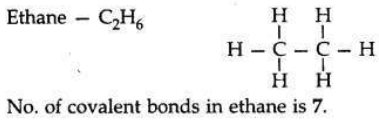
Write the number of covalent bonds in the molecule of ethane.
Answer:
CBSE Sample Papers for Class10 Science Solved Set 6 2
Question 3:
The absolute refractive indices of glass and water are 3/2 and 4/3 respectively. If the speed of light is 2 x 10⁸ m/s, calculate the speed of light in
(i) vacuum,
(ii) water.
Answer:

CBSE Class 10th Science Sample Paper 2019 part 5

Download Solved CBSE Sample Papers for Class 10 Science Set 5 2019 PDF to understand the pattern of questions asks in the board exam. Know about the important topics and questions to be prepared for CBSE Class 10 Science board exam and Score More marks. Here we have given Science Sample Paper for Class 10 Solved Set 5.
SECTION A
Question 1:
Name the two components of peripheral nervous system.
Answer:
Two components of peripheral nervous system:
  • Autonomic nervous system.
  • Voluntary nervous system.
Question 2:
What is the function of ozone in the upper atmosphere?
Answer:
Ozone layer is very important for the existence of life on earth. The function of the ozone layer in the upper atmosphere is to absorb most of the harmful ultraviolet radiations coming from the sun and prevent them from reaching the earth’s surface.
Question 3:
List four characteristics of the images formed by plane mirrors.
Answer:
The characteristics of the images formed by plane mirrors are:
(i) The image formed by a plane mirror is virtual and erect. It cannot be received on a screen.
(ii) The image formed by a plane mirror is of the same size as the object.
(iii) The image formed by a plane mirror is at the same distance behind the mirror as the object is in front of the mirror.
(iv) The image formed in a plane mirror is laterally inverted.
Question 4:
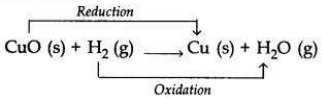
When hydrogen gas is passed over heated copper (II) oxide, copper and steam are formed. Write the balanced chemical equation for this reaction and state (i) the substance oxidized and (ii) the substance reduced in the reaction.
Answer:
CBSE Sample Papers for Class 10 Science Solved Set 5 4
(i) Substance oxidized = H2 (Hydrogen gas)
(ii) Substance reduced = CuO (Copper oxide)
Question 5:
What is meant by “sustainable management”? Why is reuse considered better than recycling?
Answer:
The development and management of resources in such a way which meets the current basic human needs and also preserves the resources for the needs of future generations, is called sustainable management.
The process of ‘reuse’ is considered better than the process of ‘recycling’ because recycling requires the use of a large amount of energy and money whereas no energy is required for reusing materials.
Question 6:
State reason for the following:
(i) Lemon is used for restoring the shine of tarnished copper vessels.
(ii) A metal sulphide is converted into its oxide to extract the metal from the sulphide ore.
(iii) Copper wires are used in electrical connections.
Answer:
(i) When a copper object remains in damp air for a considerable time, then copper reacts slowly with carbon dioxide and water in air to form a green coating of basic copper carbonate on its surface. If corroded copper vessels are treated with lemon which is acidic in nature, the acid solution dissolves green coloured basic copper carbonate and makes them look shiny.
(ii) It is easier to obtain metals from their oxides (by reduction) than from sulphides. So before reduction, the metal sulphide ore is converted into metal oxide.
(iii) Copper metal is the next best conductor of electricity after silver metal. So electric wires are made of copper (as silver being a costly metal can not be used for making electric wires).
Question 7:
State the kind of chemical reactions in the following examples:
(i) Digestion of food in stomach
(ii) Combustion of coal in air
(iii) Heating of limestone
Answer:
(i) Digestion of food in stomach. During digestion, the complex food is broken into simpler form. Therefore, it is a type of decomposition reaction.
(ii) Combustion of coal is air. During combustion the coal bums in air to form CO2, H2O along with the evolution of heat. Thus, it is a type of exothermic decomposition reaction.
(iii) Heating of limestone. When limestone is heated strongly, it breaks into CO2 and lime. Thus, it is a type of thermal decomposition reaction.
Question 8:
The rate of breathing in aquatic organisms is much faster than that seen in terrestrial organisms. Give reason. State the pathway of air from nostrils to the lungs in human beings.
Answer:
The animals which live in water (aquatic animals) use the oxygen dissolved in water to carry out respiration. Since the amount of dissolved oxygen in water is low as compared to the amount of oxygen in the air, therefore, the rate of breathing in aquatic animals is much faster than in terrestrial animals. A faster rate of breathing provides more oxygen to aquatic animals.
Pathway of air in human beings:
Nostrils → Pharynx → Larynx → Trachea → Lungs
OR
Mention three characteristic features of hormonal secretions in human beings.
Answer:
(i) A group of endocrine glands which produces various hormones is called an endocrine system. The endocrine system is also called hormonal system.
(ii) The endocrine system also helps in coordinating the activities of our body. The endocrine system in our body consists of a number of glands (or tissues) which make, store, and release chemicals called hormones.
(iii) The working of endocrine glands is controlled by our nervous system. The hormones produced by endocrine glands act as messengers between the nervous system and the organs of our body.
Question 9:
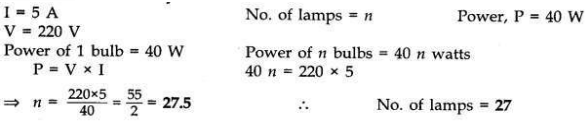
A circuit has la line of 5 A. How many lamps of rating 10W; 220V can simultaneously run on this line safely?
Answer:
CBSE Sample Papers for Class 10 Science Solved Set 5 9
Question 10:
Amit lives in Delhi and is much concerned about the increasing electricity bill of his house. He took some steps to save electricity and succeeded in doing so.
(i) Mention any two steps that Amit might have taken to save electricity.
(ii) Amit fulfilled his duty towards the environment by saving electricity. How?
(iii) Which alternative source of energy would you suggest Amit to use?
Answer:
(i)
• He can use energy efficient electrical appliances to save electricity. This can be done by using CFL bulbs and tube lights in place of conventional filament type electric bulbs.
• Use solar water heater instead of electrical geyser.
(ii) By saving electricity, Amit is contributing in his small way towards reducing environmental degradation. Most of the electrical appliances use electrical energy which is generated by burning fossil fuel. The burning of fossil fuels causes air pollution. The production of hydroelectricity causes ecological imbalance. Therefore, by using less electricity he is indirectly causing less pollution.
(iii) He can use solar energy devices like solar cooker, solar water heater and solar cells. With the help of an example, explain the process of hydrogenation.
Question 11:
With the help of an example, explain the process of hydrogenation Mention the essential conditions for the reaction and state the change in physical property with the formation of the product.
Answer:
Process of hydrogenation:
CBSE Sample Papers for Class 10 Science Solved Set 5 11
The addition of hydrogen to an unsaturated hydrocarbon to obtain a saturated hydrocarbon is called hydrogenation.
Essential conditions for the reaction are:
(i) Presence of an unsaturated hydrocarbon.
(ii) Presence of a catalyst such as nickel (Ni) or palladium.
Changes observed:
• Change observed in the physical property is the change of unsaturated compound from the liquid state to saturated compound in solid state.
• The boiling or melting points of a product is increased.
Question 12:
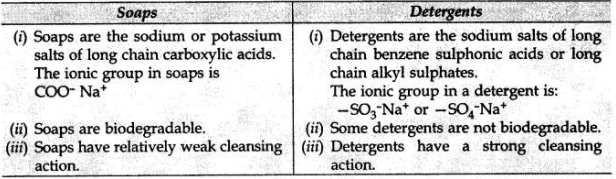
What is the difference between the molecules of soaps and detergents, chemically? Explain the cleansing action of soaps.
Answer:
Difference between molecules of soaps and detergents
CBSE Sample Papers for Class10 Science Solved Set 5 12 ii
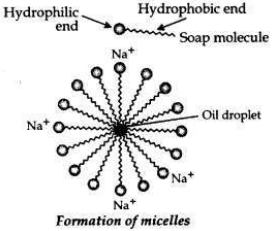
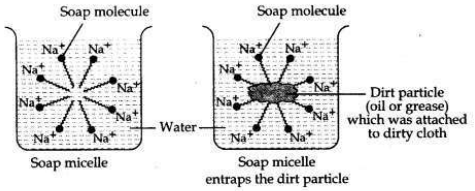
Action of soap in removing an oily spot from a piece of cloth. Soaps are molecules in which the two ends have differing properties, one is hydrophilic, that is, it dissolves in water, while the other end is hydrophobic, that is, it dissolves in hydrocarbons. When soap is at the surface of water, the hydrophobic ’tail’ of soap will not be soluble in water and the soap will align along the surface of water with the ionic end in water and the hydrocarbon ’tail’ protruding out of water. Inside water, these molecules have a unique orientation that keeps the hydrocarbon portion out of the water.
CBSE Sample Papers for Class10 Science Solved Set 5 12
This is achieved by forming clusters of molecules in which the hydrophobic tails are in the interior of the cluster and the ionic ends are on the surface of the cluster. This formation is called a micelle. Soap in the form of a micelle is able to clean, since the oily dirt will be collected in the centre of the micelle. The micelles stay in solution as a colloid and will not come together to precipitate because of ion-ion repulsion. Thus, the dirt suspended in the micelles is also easily rinsed away.
CBSE Sample Papers for Class10 Science Solved Set 5 12 i
OR
How many groups and periods are there in the modem periodic table? How do the atomic size and metallic character of elements vary as we move:
(i) down a group and (ii) from left to right in a period?
Solution:
There are 18 groups and 7 periods in the modem periodic table.
(i) Atomic size and metallic character of the elements increases down a group.
(ii) • Atomic size and metallic character of elements decreases from left to right in a period.
• Metallic character of the element is decreased.
Question 13:
What is DNA copying? State its importance.
Answer:
A process in which a DNA molecule produces two similar copies of itself in a reproducing cell through chemical reaction is a called DNA copying.
(i) It transmits the characteristics from parents to the next generation (offspring).
(ii) It causes increased variations in the population.
Question 14:
To construct a ray diagram we use two rays of light which are so chosen that it is easy to determine their directions after reflection from the mirror. Choose these two rays and state the path of these rays after reflection from a concave mirror. Use these two rays to find the nature and position of the image of an object placed at a distance of 15 cm from a concave mirror of focal length 10 cm.
Answer:
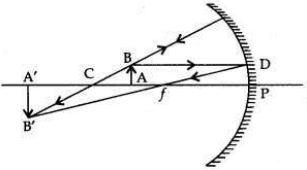
Ray 1. When an incident ray of light is parallel to the principal axis of a concave mirror, its reflected ray must pass through the principal focus of the concave mirror.
Ray 2. A ray passing through the principal focus emerge parallel to the principal axis
CBSE Sample Papers for Class10 Science Solved Set 5 14
Focal length = 10 cm;
Then centre of curvature, C = 20 cm Object is placed at 15 cm, i.e., between F & C When the object is between F and C (centre of curvature):
The image formed is real, inverted and magnified. It is formed beyond C.
Question 15:
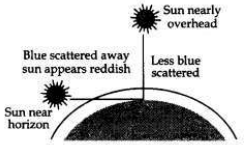
With the help of a labelled diagram, explain why the sun appears reddish at the sunrise and the sunset.
Answer:
CBSE Sample Papers for Class10 Science Solved Set 5 15
At the time of sunrise and sunset when the sun is near the horizon, the sunlight has to travel the greatest distance through the atmosphere to reach us. During the long journey of sunlight, most of the shorter wavelength blue-colour present in it is scattered out and away from our line of sight so, the light reaching us directly from the rising sun or setting sun consists mainly of longer wavelength red colour due to which the sun appears red.
Due to the same reason, the sky surrounding the rising sun and setting sun also appears red. Thus, at sunrise and sunrise, the sun itself as well as the surrounding sky appear red.
Question 16:
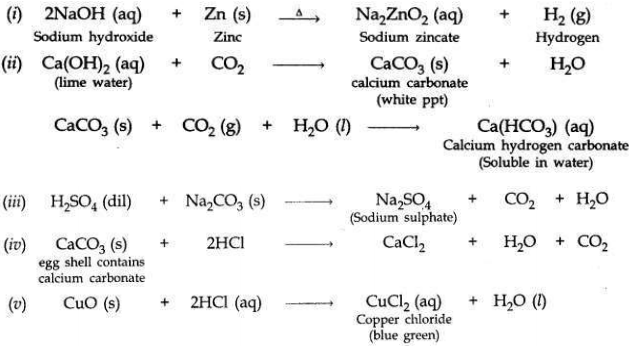
Write balanced chemical equations for the following statements:
(i) NaOH solution is heated with zinc granules.
(ii) Excess of carbon dioxide gas is passed through lime water.
(iii) Dilute sulphuric acid reacts with sodium carbonate.
(iv) Egg shells are dropped in hydrochloric acid.
(v) Copper (II) oxide reacts with dilute hydrochloric acid.
Answer:
CBSE Sample Papers for Class10 Science Solved Set 5 16
Question 17:
(a) Write three main functions of the nervous system.
(b) In the absence of muscle cells, how do plant cells show movement?
Answer:
(a) Main functions of the nervous system:
• Coordinate the activities of the body.
• Helps all other systems of the body to work together.
• The nervous system receives information from the surroundings, processes it, interprets it and then responds accordingly.
(b) The movement in any part of a plant is usually a growth movement or change in shape of body parts.
  • The movements of the plant part are usually caused by an unequal growth in its two regions by the action of plant hormones, under the influence of the stimuli like light, force of gravity, chemical substances, water, touch etc.
  • The change in shape occurs by changing the amount of water in the body part. Water causes swelling and shrinking which causes movement.
Question 18:
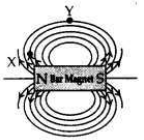
(a) Draw magnetic field lines of a bar magnet. “Two magnetic field lines never intersect each other.” Why?
(b) An electric oven of 1.5 kW is operated in a domestic circuit (220 V) that has a current rating of 5 A. What result do you expect in this case? Explain.
Answer:
CBSE Sample Papers for Class10 Science Solved Set 5 18
(a) Two magnetic field lines do not intersect one another. The direction of magnetic field lines is always from north pole to south pole. If the two magnetic field lines do intersect, it means at the point of intersection the compass needle
CBSE Sample Papers for Class10 Science Solved Set 5 18 i
Now the current drawn by the oven is 6.8 A which is very high but the fuse in this circuit is only 5 A capacity. When a very high current of 6.8 A flows through 5 A fuse, the fuse wire will get heated too much, melt and break the circuit, cutting off the power supply.
OR
What is meant by resistance of a conductor? Name and define its SI unit. List the factors on which the resistance of a conductor depends. How is the resistance of a wire affected if —
(i) its length is doubled,
(ii) its radius is doubled?
Answer:
The property of a conductor due to which tends to stop the flow of current through the conductor is called resistance.
SI unit is ohm. When a potential difference of IV across a wire gives rise to IA current through the wire, then the resistance is said to be 1 ohm (1 Q).
The resistance of conductor depends on length, thickness, nature of material and temperature of conductor.
(i) If length is doubled, then R is doubled because the resistance of a conductor is directly proportional to length.
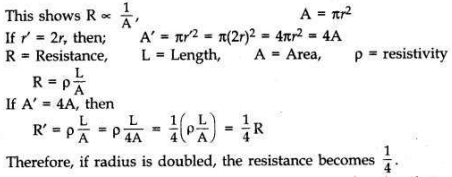
(ii) Resistance of a conductor is inversely proportional to the square of its diameter or area of cross-section.
CBSE Sample Papers for Class10 Science Solved Set 5 18 ii
Question 19:
Explain why carbon forms compounds mainly by covalent bond. Explain in brief two main reasons for carbon forming a large number of compounds. Why does carbon form strong bonds with most other elements?
Answer:
CBSE Sample Papers for Class10 Science Solved Set 5 19
Since, carbon has 4 electrons in its outermost shell so, it should either lose or gain 4 electrons to achieve the inert gas configuration and become stable.
(i) It could gain four electrons forming C4- anion. But it would be difficult for the nucleus with six protons to hold on to ten electrons due to inter electronic repulsion.
(ii) It could lose 4 electrons forming C4+ cation. But it would require a large amount of energy to remove four electrons from its outermost shell.
Thus, it forms compounds mainly by covalent bonds.
Two properties of carbon which lead to huge number of carbon compounds are:
(i) Catenation. Catenation is the unique property of carbon atoms to form bonds with other atoms of carbon giving rise to large molecules.
(ii) Tetravalency. Since carbon has a valency of 4, it is capable of bonding with 4 other atoms of carbon or atoms of some other monovalent element.
The reason for the formation of strong bonds by the carbon atoms is their small atomic size. Due to the small size of carbon atoms their nuclei hold the shared pairs of electrons between atoms strongly, leading to the formation of strong covalent bonds. The carbon atoms also form strong covalent bonds with the atoms of other elements such as hydrogen, oxygen, nitrogen, sulphur, chlorine and other elements.
Question 20:
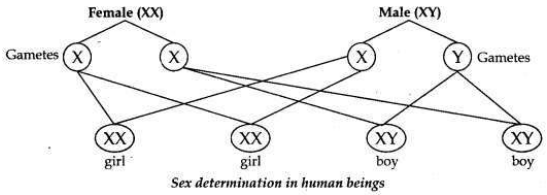
How many pairs of chromosomes are present in human beings? Out of these how many are sex chromosomes? How many types of sex chromosomes are found in human beings? “The sex of a newborn child is a matter of chance and none of the parents may be considered responsible for it”. Draw a flow chart showing determination of sex of a newborn to justify this statement.
Answer:
• There are 23 pairs of chromosomes present in human beings.
• There is 1 pair of sex chromosomes present in human beings.
• The chromosomes which determine the sex of a person are called sex chromosomes. There are two types of sex chromosomes, one is called X chromosome and the other is called Y chromosome. Males contain one X chromosome and one Y chromosome (XY), while females contain two X chromosomes (XX).
Flow chart showing determination of sex of a child.
(i) A male has one X-chromosome and one Y-chromosome. Thus half the male gametes have X-chromosomes and the other half have Y-chromosomes.
(ii) A female has two X-chromosomes. Thus all female gametes have only X- chromosomes.
(iii) If a sperm carrying Y-chromosome fertilises an ovum carrying X- chromosome, then the child born will be a boy.
(iv) If a sperm carrying X-chromosome fertilises an ovum carrying X- chromosome, then the child born will be a girl.
CBSE Sample Papers for Class10 Science Solved Set 5 20
Therefore it is the sperm from the father which determines the sex of the child.
Question 21:
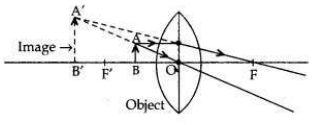
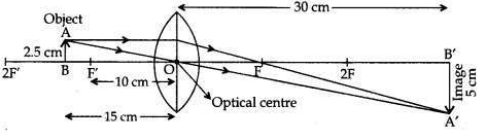
“A convex lens can form a magnified erect as well as magnified inverted image of an object placed in front of it.” Draw ray diagram to justify this statement stating the position of the object with respect to the lens in each case.
An object of height 4 cm is placed at a distance of 20 cm from a concave lens of focal length 10 cm. Use lens formula to determine the position of the image formed. 5 Answer:
Answer:
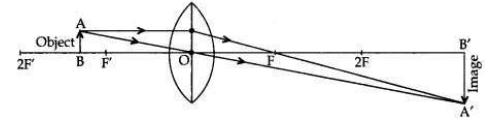
• A convex lens can form a magnified erect image when the object is placed between the optical centre and principal focus of the convex lens (i.e., between O and F’).
CBSE Sample Papers for Class10 Science Solved Set 5 21
• A convex lens can form a magnified inverted image when the object is placed between focus and the centre of curvature (i.e., between F’ and 2F’).
CBSE Sample Papers for Class10 Science Solved Set 5 21 i
• Object height, n = 4 cm;
Object distance, u = -20 cm Nature of the lens = concave lens; Focal length = f = -10 cm Image distance, v = ?
According to the lens formula,
CBSE Sample Papers for Class10 Science Solved Set 5 21 ii
So, image is formed at 6.66 cm from lens on same side. Image is erect, virtual and diminished in size.
SECTION B
Question 22:
An iron nail is dipped in the solution of copper sulphate for about 30 minutes, state the change in colour observed. Give the reason for the change.
Answer:
Iron is more reactive than Cu. So it displaces Cu from copper sulphate solution. Thus, blue colour of the CuS04 solution fades and colour of the solution turns green due to the formation of ferrous sulphate Solution. This is a displacement reaction.
CuSO4 (aq) + Fe (s) —> FeSO4 (aq) + Cu (s)
(Blue)                                            (Green)
Question 23:
A student while verifying Ohm’s law calculated the value of resistance of the resistor for each set of observation. However, the values of resistance were slightly different from the actual value. Is his experiment wrong? Justify your answer.
Answer:
His experiment is correct since some of the current is utilized to overcome the resistance of the wires of the circuit and instruments like ammeter and
voltmeter. Thus the experimental values of resistance were different from the actual value of resistance.
Question 24:
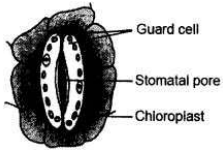
Draw a labelled diagram of stomatal apparatus with closed stomatal pore.
Answer:
CBSE Sample Papers for Class10 Science Solved Set 5 24
Question 25:
List two observations which you make when you add a pinch of sodium hydrogen carbonate to acetic acid in a test tube. Write the chemical equation for the reaction that occurs.
Answer:
When a pinch of sodium hydrogen carbonate is added to acetic acid in a test tube, there are two observations:
(i) Brisk effervescence
(ii) Evolution of a colourless and odourless gas which is CO2.
CH3 COOH (aq) + NaHCO3 (s) -> CH3 COONa (aq) + H2O (I) + CO2 (g) ↑
Question 26:
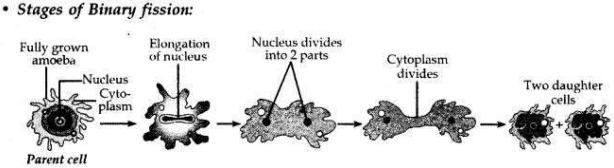
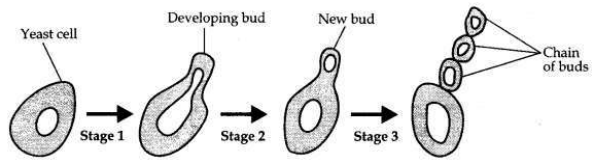
Name the type of asexual reproduction in which two individuals are formed from a single parent and the parental identity is lost.
Draw the initial and the final stages of this type of reproduction. State the event with which this reproduction starts.
Answer:
• Binary fission is a type of asexual reproduction in which two individuals are formed from a single parent and the parental identity is lost.
• This reproduction starts with the elongation of the nucleus.
CBSE Sample Papers for Class10 Science Solved Set 5 26
Question 27:
To find the image-distance for varying object-distances in case of a convex
lens, a student obtains on a screen a sharp image of a bright object placed very far from the lens. After that he gradually moves the object towards the lens and each time focuses
(a) In which direction-towards or away from the lens, does he move the screen to focus the object?
(b) What happens to the size of image—does it increase or decrease?
(c) What happen when he moves the object very close to the lens?
Answer:
fa) He moves the screen away from iens to focus the object, l b) The size of the image increases.
Ic) When the object is placed very close to the lens, then no image will be formed on the screen. As now image formed is erect and virtual.

CBSE Class 10th Science Sample Paper 2019 part 4

Board – Central Board of Secondary Education, cbse.nic.in
Subject – CBSE Class 10 Science
Year of Examination – 2019.

Solved CBSE Sample Papers for Class 10 Science Set 4

GENERAL INSTRUCTIONS
I. The Question Paper comprises of two sections, A and B. You are to attempt both the sections.
II. All questions are compulsory.
III. All questions of Section A and all questions of Section B are to be attempted separately.
IV. Question numbers I to 2 in Section A are one mark questions. These are to be answered in one word or in one sentence.
V. Question numbers 3 to 5 in Section A are two marks questions. These are to be answered in about 30 words each.
VI. Question numbers 6 to 15 in Section A are three marks questions. These are to be answered in about 50 words each.
VII. Question numbers 16 to 21 in Section A are five marks questions. These are to be answered in about 70 words each.
VIII. Question numbers 22 to 27 in Section B are questions based on practical skills and are five marks questions.
SECTION A
Question 1:
Name one plant hormone which inhibits growth. Write its one more function.
Answer:
Abscisic acid is a plant hormone which functions mainly as a growth inhibitor.
• It promotes the dormancy in seeds and buds. It promotes the closing of stomata.
• It promotes the wilting and falling of leaves.
Question 2:
Write the name and structure of an alcohol with three carbon atoms in its molecule.
Answer:
Name of an alcohol: 1-Propanol
CBSE Sample Papers for Class10 Science Solved Set 4 2
Question 3:
Name the type of mirrors used in the design of solar furnaces. Explain how high temperature is achieved by this device.
Answer:
Concave mirrors are used in the design of solar furnaces. When a solar furnace is placed at the focus of a large concave mirror (called reflector), it focuses a parallel beam of light on the furnace, as a result a temperature is achieved after some time.
Question 4:
“What was Chipko Andolan”? How did this Andolan ultimately benefit the local people and the environment?
Answer:
Chipko Movement. Chipko Movement is an example of contribution of common people towards the conservation of forests. The Chipko Movement also called ’Hug the tree’ movement originated from an incident in a remote village called ’Reni’ in Garhwal (Himalayas), where the people of this village clasped the tree trunks with their arms to protect them from being cut down by a contractor’s workers. The people acted this way because they knew that this mass deforestation would spoil their healthy environment. The forest trees were thus saved.
The Chipko Movement quickly spread across all the communities and helped in the conservation of forests and thus helped in safeguarding the environment.
Question 5:
A metal ’M’ is found in nature as its carbonate. It is used in the galvanization of iron.
Identify ’M’ and name its ore. How will you convert this ore into free metal?
Answer:
’M’ = Zinc metal
Zinc occurs as Zinc Carbonate in calamine ore, ZnCCh.
Zinc can be extracted from the ore by:
(i) Zinc Carbonate is first converted into Zinc Oxide by calcination. When calamine ore (zinc carbonate) is heated strongly in the absence of air, it decomposes to form zinc oxide and carbon dioxide.
CBSE Sample Papers for Class10 Science Solved Set 4 5
(ii) Zinc metal is then extracted from zinc oxide bv reduction with carbon (coke).
CBSE Sample Papers for Class10 Science Solved Set 4 5 i
Question 6:
(i) Name two waste products which are stored in old xylem in plants.
(ii) Name the process by which plants get rid of excess water. Name the pores through which this process takes place.
Answer:
(i) Resin and gums are the two wastes which are stored in old xylem in plants.
(ii) • Transpiration is the process by which plants get rid of excess water.
• Stomatal pores are the pores through which transpiration takes place.
Question 7:
(a) In electrolysis of water, why is the volume of gas collected over one electrode double that of gas collected over the other electrode?
(b)
(i) What is observed when a solution of potassium iodide is added to a solution of lead nitrate taken in a test tube?
(ii) What type of reaction is this?
(iii) Write a balanced chemical equation to represent the above reaction.
Answer:
(a) In electrolysis of water (H2O), the hydrogen goes to one test tube and oxygen goes to to another. The two electrodes collect H and O separately.
Since water (Hsub>2O) consists of 2 parts of hydrogen and 1 part of oxygen, so, the volume of hydrogen gas (Hsub>2) collected over cathode (negative electrode) is double the volume of oxygen gas (Osub>2) collected over anode (positive electrode).
(b)
(i) When potassium iodide solution is added to lead nitrate solution, then a yellow precipitate of lead iodide is produced along with potassium nitrate solution.
(ii) This is a double displacement reaction.
CBSE Sample Papers for Class10 Science Solved Set 4 7
OR
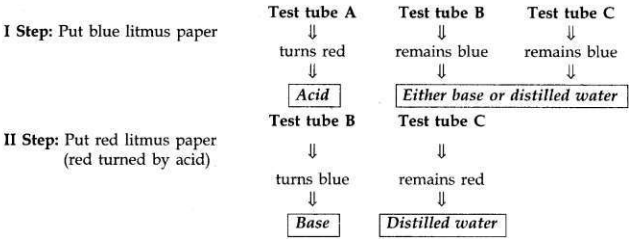
You are provided with three test tubes A, B and C which contain distilled water, acidic solution and basic solution respectively. If you are given blue litmus paper only, how will you identify the contents of each test tube?
Answer:
  •  First take three strips of blue litmus paper and dip one in each test tube.
  •  The liquid in test tube A turns blue litmus to red. It means test tube A contains acid because (acid turns blue litmus to red).
  •  If other two test tubes do not change the colour of blue litmus paper, it shows that one of them contains a base and the other contains distilled water.
  •  Now put the blue litmus paper which is turned red by the acid of test tube A in the remaining two test tubes.
  • If the liquid of test tube B turns that red litmus paper to blue again, it shows that it is a base.
  • The liquid in test tube C does not turn the colour of either blue litmus or red litmus thus is distilled water.
CBSE Sample Papers for Class10 Science Solved Set 4 7 i
Question 8:
State the function of receptors in our body. Think of any three situations where receptors in the body do not work properly. Mention the problems which are likely to arise.
Answer:
  • Receptors are present in all parts of our body, for example, in the skin, eyes, nose, tongue, etc.
  • A receptor is a cell (or a group of cells) in a sense organ which is sensitive to a particular type of stimulus such as light, sound, smell, taste, heat, pressure, etc.
  • The different sense organs contain receptors for detecting different stimuli. The eyes have light receptors called photoreceptors (which can detect light). Ears have sound receptors called photoreceptors (which can detect the sounds).
  • The nose has smell receptors called olfactory receptors which can detect the smell. Tongue has taste receptors which are called gustatory receptors which detect taste.
  • Skin has receptors called thermoreceptors which detect touch, pressure.
  • When receptors do not work properly, the environmental stimuli are not able to create nerve impluses and the body does not respond.
  • When receptors are damaged, the external stimuli transferring signals to the brain are not felt.
    For example,
  • during fever, taste buds do not work properly and as a result, taste of the food eaten is not felt properly thus enzyme secretion is also affected.
  • when a person is suffering from a cold, the nostrils are filled with mucus. Then smell of the surrounding is not felt properly.
  • This is due to interruption in reacting to the sense of smell by the olfactory receptor.
  • when skin receptors are damaged, and we accidentally touch a hot object, then our hands might get burnt as the damaged receptor cannot perceive the external stimuli of heat and pain.
Question 9:
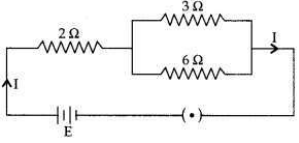
In the given electric circuit if the current flowing through 3 Ω resistor is 1A, find the voltage of the battery and the current I drawn from it.
CBSE Sample Papers for Class10 Science Solved Set 4 9Q
Answer:
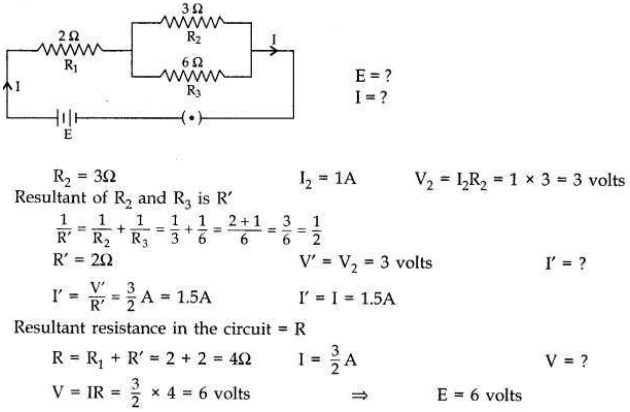
CBSE Sample Papers for Class10 Science Solved Set 4 9
Question 10:
State the principle of working of ocean thermal conversion plant. Explain how the plant works? Write one essential condition for it to operate properly.
Answer:
The energy available due to the difference in the temperature of water at the surface of the ocean and at deeper levels is called Ocean Thermal Energy (OTE).
Condition for it to operate properly:
  • Ocean thermal energy plants can operate if the temperature difference between the water at the surface and water at depths up to 2 km is 293 K (20°C) or more.
  • Working. The devices used to harness ocean thermal energy are called ocean thermal energy conversion power plants (or OTEC power plants).
  • A temperature difference of 20°C (or more) between the surface water of ocean and deeper water is needed for operating OTEC power plants.
  • In one type of OTEC power plant, the warm surface water of ocean is used to boil a volatile liquid like ammonia or a CFC.
  • The high pressure vapours of the liquid are then used to turn the turbine of a generator and produce electricity.
  • The colder water from the deeper ocean is pumped up to cool the used up vapours and convert them again into a liquid. This process is repeated again and again.
Question 11:
An aldehyde as well as a ketone can be represented by the same molecular formula, say C3H6O. Write their structures and name them. State the relation between the two in the language of science.
Answer:
Molecular formula: C3H6O
CBSE Sample Papers for Class10 Science Solved Set 4 11
• They are called isomers because both have same molecular formula but different structural formula (having different functional groups). They do not have same physical properties since their functional group is different.
Question 12:
An element ’X’ has mass number 35 and number of neutrons 18. Write atomic number and electronic configuration of ’X’. Also write group number, period number and valency of’X’.
Answer:
’X’ –> Mass number = 35
No. of neutrons = 18
CBSE Sample Papers for Class10 Science Solved Set 4 12
Question 13:
Define reproduction. How does it help in providing stability to the population of species?
Answer:
  • The production of new organisms from the existing organisms of the same species is known as reproduction. It is essential for the survival of a species on earth.
  • It helps in replacing the lost section of the population due to death and various other causes.
  • Populations of organisms live in well defined places called niches in the ecosystem using their ability to reproduce.
  • Reproduction involves DNA copying which is the source of information for making proteins thereby controlling body design.
  • These body designs allow the organism to use a particular niche for the stability of the population of a species.
  • Minor variations may also lead to the stability of the species.
OR
Explain the term “Regeneration” as used in relation to reproduction of organisms. Describe briefly how regeneration is carried out in multicellular organisms like Hydra.
Answer:
  • Regeneration is a mode of asexual reproduction in some organisms. The process of getting back a full organism from its body parts is called regeneration.
  • The simple multicellular animals like hydra and planaria show regeneration.
Regeneration in hydra:
  • If the body of hydra gets cut into a number of pieces, then each body piece can regenerate into a complete hydra by growing all the missing parts.
  • The regeneration of an organism from its cut body part occurs by the process of growth and development.
  • The cells of cut body parts divide rapidly to make a ball of cells.
  • The cells then become specialised to form different types of tissues which again form various organs and body parts.
Question 14:
“Two areas of study namely ’evolution’ and ’classification’ are interlinked”. Justify this statement.
Answer:
  • Classification of organisms is based on relative similarities and differences in their internal and external structures.
  • Similarities among organisms will allow us to group them and study the groups and classify them. Some basic characteristics will be shared by most organisms.
  • The more characteristics the two species will have in common, the more closely they are related. The more closely they are related, the more recently they have had a common ancestor.
  • So we can say that classification of a species is in fact a reflection of their evolutionary relationship.
Question 15:
The image of an object formed by a mirror is real, inverted and is of magnification -1. If the image is at a distance of 40 cm from the mirror, where is the object placed? Where would the image be if the object is moved 20 cm towards the mirror? State reason and also draw ray diagram for the new position of the object to justify your answer.
Answer:
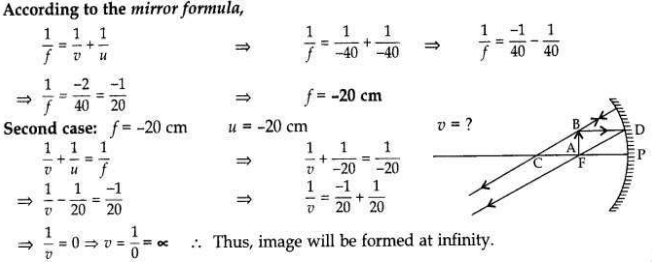
Magnification, m = -1; Image is real and inverted; Image distance = -40 cm
CBSE Sample Papers for Class10 Science Solved Set 4 15
When object distance is equal to the image distance and image is real, then the object is placed at C. If the object is moved 20 cm towards the mirror, then its new position would be at the focus of the mirror.
CBSE Sample Papers for Class10 Science Solved Set 4 15 i
Question 16:
(a) Explain any two physical properties of ionic compounds giving reason.
(b) List any two metals found in free state in earth’s crust. Where are they located in activity series?
(c) Metals towards the top of the activity series can not be obtained from their compounds by reducing with carbon. Why?
Answer:
(a) Physical properties of ionic compounds:
(i) Ionic compounds are usually crystalline solids because their oppositely charged ions attract one another strongly and form a regular crystal structure.
(ii) Ionic compounds have high melting and high boiling points. The ionic compounds are made up of +ve and -ve ions. There is a strong force of attraction between the oppositely charged ions, so a lot of heat energy is required to break this force of attraction and melt or boil the ionic compounds.
(b) Gold and platinum metals are found in free state in the earth’s crust. These metals are located at the bottom in the activity series.
(c) Metals towards the top of the activity series are highly reactive. The oxides of highly reactive metals are very stable and can not be reduced by ’carbon’ to obtain free metals because these metals have more affinity for oxygen than carbon.
Question 17:
(a) Define reflex action. State its significance.
(b) How do plants respond to external stimuli?
Answer:
(a) A reflex action is an automatic response to a stimulus. The simplest form of response in the nervous system is reflex action. This is a rapid, automatic response to a stimulus which is not under the voluntary control of the brain. It is described as an involuntary action. The pathway taken by nerve impulses in a reflex action is called the reflex arc. Reflex actions are the actions which we perform without thinking to protect ourselves. For example, coughing is a reflex action which clears our windpipe. The pupils of our eyes get smaller in bright light. This reflex action protects the retina of our eyes from damage due to much light. The pupils of our eyes get bigger in dim light so as to help us see properly even in dim light.
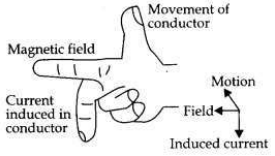
(b) Plants respond to external stimuli such as light, touch, etc. A growth movement of a plant part in response to an external stimulus in which the direction of stimuli determines the direction of response in called tropism.
  • If the growth of a plant part is towards the stimuli, it is called positive tropism.

  • If the growth of a plant part is away from the stimulus, then it is called negative tropism.
Types of tropism:
  • The movement of a plant part in response to light is called phototropism.
  • The movement of a plant part in response to gravity is called geotropism.
  • The movement of a plant part in response to chemicals is called chemotropism.
  • The movement of a plant part in response to water is called hydrotropism.
  • The directional growth movement of a plant part in response to the touch of an object is called thigmotropism.
  • Nasties (or Nastic Movements). The movement of a plant part in response to an external stimulus in which the direction of response is not determined by the direction of stimulus is called nastic movement.
  • The folding up of a the leaves of a sensitive plant on touching is an example of nastic movement. Here the stimulus is touch.
  • The opening up of the petals of dandelion flowers in morning in bright light and closing in the evening when the light fades is an example of nastic movement. In this case the stimulus is light.
Question 18:
State Ohm’s law. Draw a labelled circuit diagram to verify this law in the laboratory. If you draw a graph between the potential difference and current flowing through a metallic conductor, what kind of curve will you get? Explain how would you use this graph to determine the resistance of the conductor.
Answer:
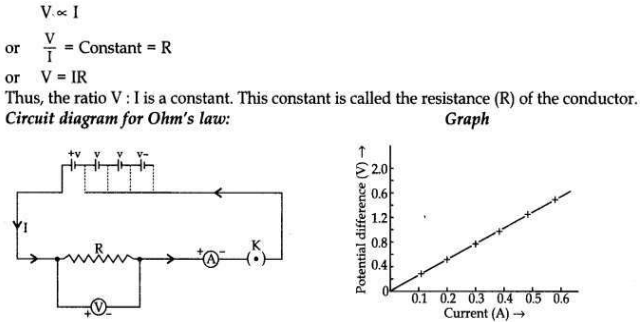
Ohm’s law states that the electric current, through a conductor, is directly proportional to the potential difference across its two ends when, other physical conditions like temperature, etc., remain constant.
CBSE Sample Papers for Class10 Science Solved Set 4 18
Explanation. If a graph is drawn between the potential difference (V) and current (I), the graph is found to be a straight line passing through the origin. This shows current is directly proportional to the potential difference. Thus the ratio V/l remains constant. This constant is called the resistance of the conductor. The gradient of the straight line graph is related to the resistance (R) of the conductor.
OR
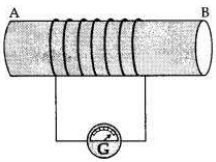
(a) A coil of insulated wire is connected to a galvanometer. What would be seen if a bar magnet with its south pole towards one face of the coil is
(i) moved quickly toward it
(ii) moved quickly away from it
(iii) placed near its one face?
These activities are then repeated with north pole of the magnet. What will be the observations?
(b) Name and define the phenomenon involved in above activities.
(c) Name the rule which can determine the direction of current in each case.
Answer:
(a) A coil of insulated wire is connected to a galvanometer and if a bar magnet with its south pole towards one face of the coil is
(i) moved quickly towards it, the galvanometer is deflected towards the left.
(ii) moved quickly away from it, the galvanometer is deflected towards the right.
(iii) placed near its one face, the deflection of the galvanometer is zero.
If this activity is repeated with north pole of the magnet
CBSE Sample Papers for Class10 Science Solved Set 4 18 i
(i) If the magnet is pushed into the coil, the A- galvanometer is deflected towards the right.
(ii) It the magnet is withdrawn from the coil, the galvanometer is deflected towards the left.
(iii) If the magnet is held stationary inside the coil, the deflection of the galvanometer is zero.
(b) This phenomenon involved in this activity is ’Electromagnetic Induction’. The production of electric current by moving a magnet inside a fixed coil of wire is called electromagnetic induction.
CBSE Sample Papers for Class10 Science Solved Set 4 18 ii
(c) The direction of induced current is determined by ’Fleming’s Right Hand Rule’.
Question 19:
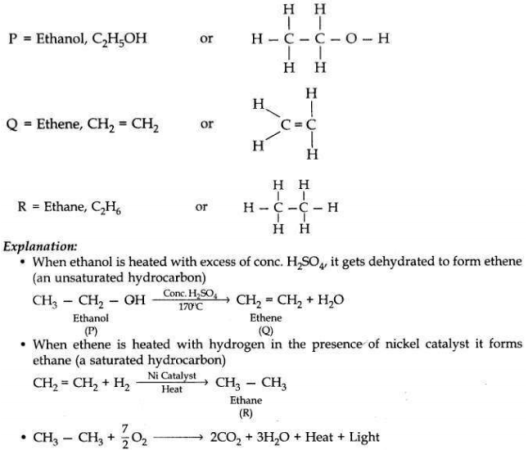
A carbon compound ’P’ on heating with excess cone. H2SO4 forms another carbon compound ’Q’ which on addition of hydrogen in the presence of nickel catalyst forms a saturated carbon compound ’R’. One molecule of ’R’ on combustion, forms two molecules of carbon dioxide and three molecules of water. Identify P, Q and R and write chemical equations for the reactions involved.
Answer:
CBSE Sample Papers for Class10 Science Solved Set 4 19
Question 20:
Define evolution. How does it occur? Describe how fossils provide us evidences in support of evolution.
Answer:
Evolution. Evolution is the sequence of gradual changes which take place in the primitive organisms over millions of years in which new species are produced.
How it occurs?
  • It is through the constant process of evolution taking place in the organisms since the origin of life that such an enormous variety of plants and animals have come to exist on this earth at present.
  • There is an inbuilt tendency to variation during reproduction due to errors in DNA copying and as a result of sexual reproduction.
Relationship between fossils and evolution:
  • Fossils are the remains of impressions of dead plants or animals which died millions of years ago. The study of fossils helps us to know about the evolution of species.
  • Fossils tell us how new species are developed from the old.
  • Fossilsprovide evidence of evolution by revealing characteristics of past organisms and the changes that have occured in these organisms to give rise to present organisms.
  • Therefore, fossils have an importance in deciding evolutionary relationship.
  • For example, a fossil called Archaeopteryx has feathered wings like birds but teeth and tail like reptiles hence suggesting that birds and reptiles had a common ancestor.
Question 21:
It is desired to obtain an erect image of an object, using concave mirror of focal length of 12 cm.
(i) What should be the range of distance of an object placed in front of the mirror?
(ii) Will the image be smaller or larger than the object? Draw a ray diagram to show the formation of image in this case.
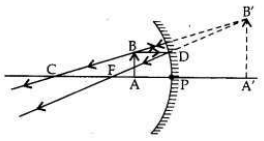
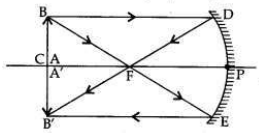
(iii) Where will the image of this object be, if it is placed 24 cm in front of the mirror? Draw a ray diagram for this situation also to justify your answer.
Show the positions of the pole, the principal focus and the centre of curvature in the above ray diagrams.
Answer:
In a concave mirror an erect image will be obtained when the object is placed between
pole and focus of the mirror.
Focal length,/= 12 cm
CBSE Sample Papers for Class10 Science Solved Set 4 21
(i) Therefore, the range of object distance is between 0 cm to <12 cm (from zero to less than 12 cm).
(ii) Image formed will be magnified, i.e., larger than the object.
(iii) If the object is placed at 24 cm in front of the mirror, it means that object is placed at 2 fi.e., at the centre of curvature (at C) of the mirror.
The real, inverted and same size (of the object) image will also be formed at 24 cm.
CBSE Sample Papers for Class10 Science Solved Set 4 21 i
SECTION B
Question 22:
To study the dependence of potential difference (V) on current I across Resistor (R), four circuit diagrams are prepared.
CBSE Sample Papers for Class10 Science Solved Set 4 22Q
(i) Select the circuit diagrams which are correct.
(ii) Give reason for the circuit diagrams which are not correct.
Answer:
(i) Circuit diagrams (I) and (III) are correct.
(ii) Circuit diagram (II) is incorrect because ammeter is always connected in series with the resistor and voltmeter is always connected in parallel to the resistor.
Circuit diagram (IV) is incorrect because the negative (-ve) terminal of the ammeter and the voltmeter is connected to the positive (+ve) terminal of the battery and there is positive (+ve) terminals connection.
Question 23:
(i) While studying the combination reaction on adding water to quick lime, name the product formed and write its colour.
(ii) While studying the decomposition reaction by heating ferrous sulphate crystals in a test-tube, a product is formed in the test-tube. Name the product and write its colour.
Answer:
(i) Quicklime (CaO) reacts vigorously with water to form slaked lime [Ca(OH)2] which is white in colour.
CBSE Sample Papers for Class10 Science Solved Set 4 23
(ii) When ferrous sulphate is heated strongly, it decomposes to form brown coloured ferric oxide and sulphur dioxide gas and sulphur trioxide gas.
CBSE Sample Papers for Class10 Science Solved Set 4 23 i
Question 24:
Identify the observed various parts of temporary mount of well stained leaf peel, when focussed under the high power of a microscope.
Answer:
Parts of temporary mount of well stained leaf peel:
(i) Stomatal aperture (opened)/(closed)
(ii) Guard cells
(iii) Chloroplast
(iv) Nucleus
(v) Epidermal cells
Question 25:
A student adds a spoon full of powdered sodium hydrogen carbonate to a flask containing ethanoic acid. List two main observations, he must note in his note book, about the reaction that takes place. Also write chemical equation for the reaction.
Answer:
When sodium hydrogen carbonate is added to a flask containing ethanoic acid, then
  • brisk effervescence will be formed because of CO2 gas escaping from the reaction mixture.
  • evolution of colourless and odourless gas. Some amount of heat is evolved during the reaction.
CH3COOH + NaHCO3 -> CH3COONa + H2O + CO2
Question 26:
A student is observing a permanent slide showing sequentially the different stages of asexual reproduction taking place in yeast. Name this process and draw diagrams of what he observes in a proper sequence.
CBSE Sample Papers for Class10 Science Solved Set 4 26Q
Answer:
The process of reproduction in yeast is budding.
Question 27:
An object of height 2.5 cm is placed at a distance of 15 cm from the optical centre ’O’ of a convex lens of focal length 10 cm. Draw a ray diagram to find the position and size of the image formed. Mark optical centre ’O’, principal focus F and height of the image on the diagram.
Answer:
CBSE Sample Papers for Class10 Science Solved Set 4 27
We hope the Solved CBSE Sample Papers for Class 10 Science Set 4, help you. If you have any query regarding CBSE Sample Papers for Class 10 Science Solved Set 4, drop a comment below and we will get back to you at the earliest.