SECTION A
Question 1:
Name the two components of peripheral nervous system.
Answer:
Two components of peripheral nervous system:
- Autonomic nervous system.
- Voluntary nervous system.
Question 2:
What is the function of ozone in the upper atmosphere?
Answer:
Ozone layer is very important for the existence of life on earth. The
function of the ozone layer in the upper atmosphere is to absorb most of
the harmful ultraviolet radiations coming from the sun and prevent them
from reaching the earth’s surface.
Question 3:
List four characteristics of the images formed by plane mirrors.
Answer:
The characteristics of the images formed by plane mirrors are:
(i) The image formed by a plane mirror is virtual and erect. It cannot be received on a screen.
(ii) The image formed by a plane mirror is of the same size as the object.
(iii) The image formed by a plane mirror is at the same distance behind the mirror as the object is in front of the mirror.
(iv) The image formed in a plane mirror is laterally inverted.
Question 4:
When hydrogen gas is passed over heated copper (II) oxide, copper and
steam are formed. Write the balanced chemical equation for this reaction
and state (i) the substance oxidized and (ii) the substance reduced in
the reaction.
Answer:
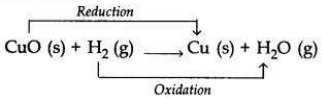
(i) Substance oxidized = H
2 (Hydrogen gas)
(ii) Substance reduced = CuO (Copper oxide)
Question 5:
What is meant by “sustainable management”? Why is reuse considered better than recycling?
Answer:
The development and management of resources in such a way which meets
the current basic human needs and also preserves the resources for the
needs of future generations, is called sustainable management.
The
process of ‘reuse’ is considered better than the process of ‘recycling’
because recycling requires the use of a large amount of energy and money
whereas no energy is required for reusing materials.
Question 6:
State reason for the following:
(i) Lemon is used for restoring the shine of tarnished copper vessels.
(ii) A metal sulphide is converted into its oxide to extract the metal from the sulphide ore.
(iii) Copper wires are used in electrical connections.
Answer:
(i) When a copper object remains in damp air for a considerable time,
then copper reacts slowly with carbon dioxide and water in air to form a
green coating of basic copper carbonate on its surface. If corroded
copper vessels are treated with lemon which is acidic in nature, the
acid solution dissolves green coloured basic copper carbonate and makes
them look shiny.
(ii) It is easier to obtain metals from their
oxides (by reduction) than from sulphides. So before reduction, the
metal sulphide ore is converted into metal oxide.
(iii) Copper metal
is the next best conductor of electricity after silver metal. So
electric wires are made of copper (as silver being a costly metal can
not be used for making electric wires).
Question 7:
State the kind of chemical reactions in the following examples:
(i) Digestion of food in stomach
(ii) Combustion of coal in air
(iii) Heating of limestone
Answer:
(i) Digestion of food in stomach. During digestion, the complex food is
broken into simpler form. Therefore, it is a type of decomposition
reaction.
(ii) Combustion of coal is air. During combustion the coal bums in air to form CO
2, H
2O along with the evolution of heat. Thus, it is a type of exothermic decomposition reaction.
(iii) Heating of limestone. When limestone is heated strongly, it breaks into CO
2 and lime. Thus, it is a type of thermal decomposition reaction.
Question 8:
The rate of breathing in aquatic organisms is much faster than that
seen in terrestrial organisms. Give reason. State the pathway of air
from nostrils to the lungs in human beings.
Answer:
The animals
which live in water (aquatic animals) use the oxygen dissolved in water
to carry out respiration. Since the amount of dissolved oxygen in water
is low as compared to the amount of oxygen in the air, therefore, the
rate of breathing in aquatic animals is much faster than in terrestrial
animals. A faster rate of breathing provides more oxygen to aquatic
animals.
Pathway of air in human beings:
Nostrils → Pharynx → Larynx → Trachea → Lungs
OR
Mention three characteristic features of hormonal secretions in human beings.
Answer:
(i) A group of endocrine glands which produces various hormones is
called an endocrine system. The endocrine system is also called hormonal
system.
(ii) The endocrine system also helps in coordinating the
activities of our body. The endocrine system in our body consists of a
number of glands (or tissues) which make, store, and release chemicals
called hormones.
(iii) The working of endocrine glands is controlled
by our nervous system. The hormones produced by endocrine glands act as
messengers between the nervous system and the organs of our body.
Question 9:
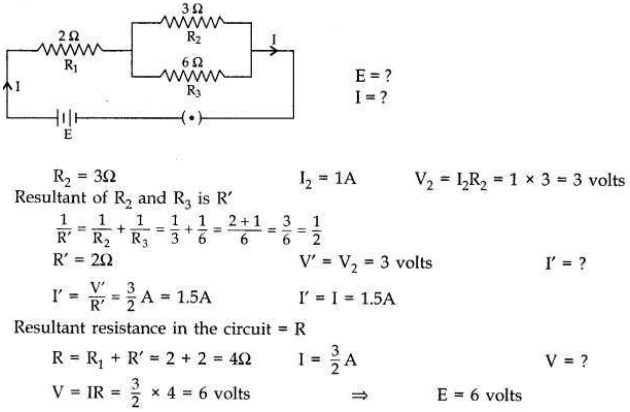
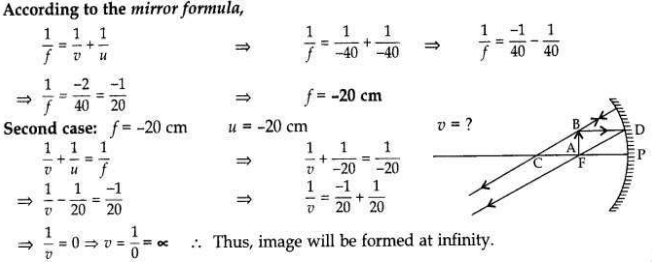
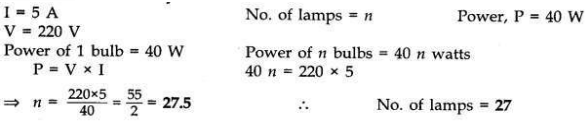
A circuit has la line of 5 A. How many lamps of rating 10W; 220V can simultaneously run on this line safely?
Answer:
Question 10:
Amit lives in Delhi and is much concerned about the increasing
electricity bill of his house. He took some steps to save electricity
and succeeded in doing so.
(i) Mention any two steps that Amit might have taken to save electricity.
(ii) Amit fulfilled his duty towards the environment by saving electricity. How?
(iii) Which alternative source of energy would you suggest Amit to use?
Answer:
(i)
• He can use energy efficient electrical appliances to save
electricity. This can be done by using CFL bulbs and tube lights in
place of conventional filament type electric bulbs.
• Use solar water heater instead of electrical geyser.
(ii)
By saving electricity, Amit is contributing in his small way towards
reducing environmental degradation. Most of the electrical appliances
use electrical energy which is generated by burning fossil fuel. The
burning of fossil fuels causes air pollution. The production of
hydroelectricity causes ecological imbalance. Therefore, by using less
electricity he is indirectly causing less pollution.
(iii) He can
use solar energy devices like solar cooker, solar water heater and solar
cells. With the help of an example, explain the process of
hydrogenation.
Question 11:
With the help of an example,
explain the process of hydrogenation Mention the essential conditions
for the reaction and state the change in physical property with the
formation of the product.
Answer:
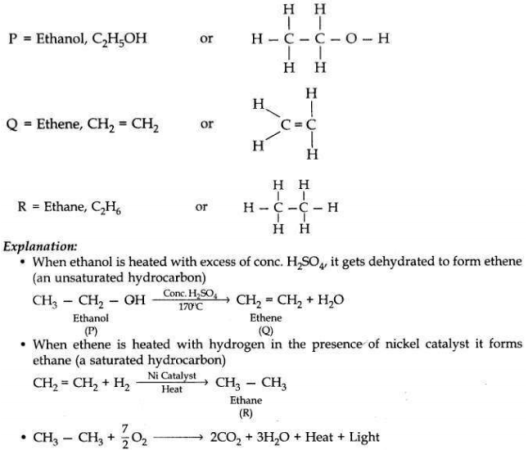
Process of hydrogenation:

The addition of hydrogen to an unsaturated hydrocarbon to obtain a saturated hydrocarbon is called hydrogenation.
Essential conditions for the reaction are:
(i) Presence of an unsaturated hydrocarbon.
(ii) Presence of a catalyst such as nickel (Ni) or palladium.
Changes observed:
• Change observed in the physical property is the change of unsaturated
compound from the liquid state to saturated compound in solid state.
• The boiling or melting points of a product is increased.
Question 12:
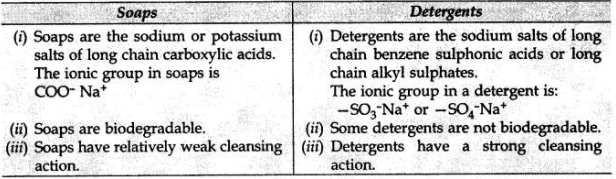
What is the difference between the molecules of soaps and detergents, chemically? Explain the cleansing action of soaps.
Answer:
Difference between molecules of soaps and detergents
Action
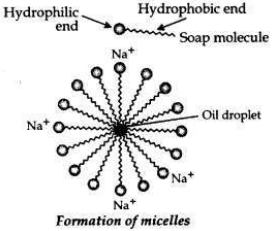
of soap in removing an oily spot from a piece of cloth. Soaps are
molecules in which the two ends have differing properties, one is
hydrophilic, that is, it dissolves in water, while the other end is
hydrophobic, that is, it dissolves in hydrocarbons. When soap is at the
surface of water, the hydrophobic ’tail’ of soap will not be soluble in
water and the soap will align along the surface of water with the ionic
end in water and the hydrocarbon ’tail’ protruding out of water. Inside
water, these molecules have a unique orientation that keeps the
hydrocarbon portion out of the water.
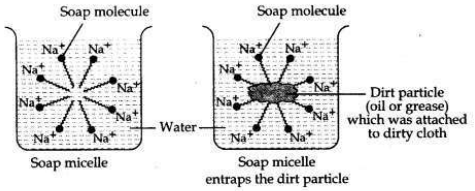
This
is achieved by forming clusters of molecules in which the hydrophobic
tails are in the interior of the cluster and the ionic ends are on the
surface of the cluster. This formation is called a micelle. Soap in the
form of a micelle is able to clean, since the oily dirt will be
collected in the centre of the micelle. The micelles stay in solution as
a colloid and will not come together to precipitate because of ion-ion
repulsion. Thus, the dirt suspended in the micelles is also easily
rinsed away.
OR
How many groups and periods are there in the modem periodic table? How
do the atomic size and metallic character of elements vary as we move:
(i) down a group and (ii) from left to right in a period?
Solution:
There are 18 groups and 7 periods in the modem periodic table.
(i) Atomic size and metallic character of the elements increases down a group.
(ii) • Atomic size and metallic character of elements decreases from left to right in a period.
• Metallic character of the element is decreased.
Question 13:
What is DNA copying? State its importance.
Answer:
A process in which a DNA molecule produces two similar copies of itself
in a reproducing cell through chemical reaction is a called DNA
copying.
(i) It transmits the characteristics from parents to the next generation (offspring).
(ii) It causes increased variations in the population.
Question 14:
To construct a ray diagram we use two rays of light which are so chosen
that it is easy to determine their directions after reflection from the
mirror. Choose these two rays and state the path of these rays after
reflection from a concave mirror. Use these two rays to find the nature
and position of the image of an object placed at a distance of 15 cm
from a concave mirror of focal length 10 cm.
Answer:
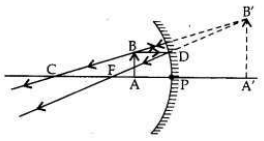
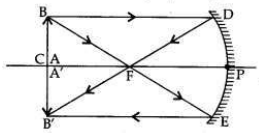
Ray 1. When
an incident ray of light is parallel to the principal axis of a concave
mirror, its reflected ray must pass through the principal focus of the
concave mirror.
Ray 2. A ray passing through the principal focus emerge parallel to the principal axis
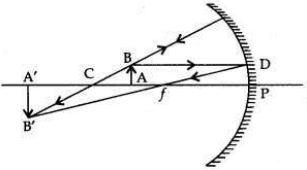
Focal length = 10 cm;
Then centre of curvature, C = 20 cm Object is placed at 15 cm, i.e.,
between F & C When the object is between F and C (centre of
curvature):
The image formed is real, inverted and magnified. It is formed beyond C.
Question 15:
With the help of a labelled diagram, explain why the sun appears reddish at the sunrise and the sunset.
Answer:
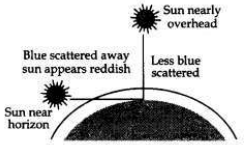
At
the time of sunrise and sunset when the sun is near the horizon, the
sunlight has to travel the greatest distance through the atmosphere to
reach us. During the long journey of sunlight, most of the shorter
wavelength blue-colour present in it is scattered out and away from our
line of sight so, the light reaching us directly from the rising sun or
setting sun consists mainly of longer wavelength red colour due to which
the sun appears red.
Due to the same reason, the sky surrounding
the rising sun and setting sun also appears red. Thus, at sunrise and
sunrise, the sun itself as well as the surrounding sky appear red.
Question 16:
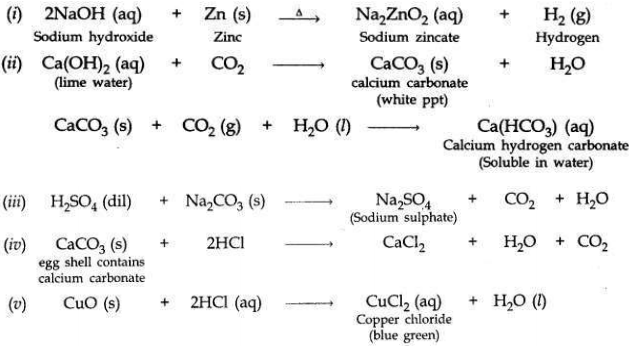
Write balanced chemical equations for the following statements:
(i) NaOH solution is heated with zinc granules.
(ii) Excess of carbon dioxide gas is passed through lime water.
(iii) Dilute sulphuric acid reacts with sodium carbonate.
(iv) Egg shells are dropped in hydrochloric acid.
(v) Copper (II) oxide reacts with dilute hydrochloric acid.
Answer:
Question 17:
(a) Write three main functions of the nervous system.
(b) In the absence of muscle cells, how do plant cells show movement?
Answer:
(a) Main functions of the nervous system:
• Coordinate the activities of the body.
• Helps all other systems of the body to work together.
• The nervous system receives information from the surroundings, processes it, interprets it and then responds accordingly.
(b) The movement in any part of a plant is usually a growth movement or change in shape of body parts.
- The
movements of the plant part are usually caused by an unequal growth in
its two regions by the action of plant hormones, under the influence of
the stimuli like light, force of gravity, chemical substances, water,
touch etc.
- The change in shape occurs by changing the amount of
water in the body part. Water causes swelling and shrinking which causes
movement.
Question 18:
(a) Draw magnetic field lines of a bar magnet. “Two magnetic field lines never intersect each other.” Why?
(b) An electric oven of 1.5 kW is operated in a domestic circuit (220
V) that has a current rating of 5 A. What result do you expect in this
case? Explain.
Answer:
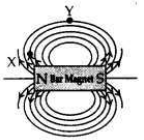
(a)
Two magnetic field lines do not intersect one another. The direction of
magnetic field lines is always from north pole to south pole. If the
two magnetic field lines do intersect, it means at the point of
intersection the compass needle

Now
the current drawn by the oven is 6.8 A which is very high but the fuse
in this circuit is only 5 A capacity. When a very high current of 6.8 A
flows through 5 A fuse, the fuse wire will get heated too much, melt and
break the circuit, cutting off the power supply.
OR
What is
meant by resistance of a conductor? Name and define its SI unit. List
the factors on which the resistance of a conductor depends. How is the
resistance of a wire affected if —
(i) its length is doubled,
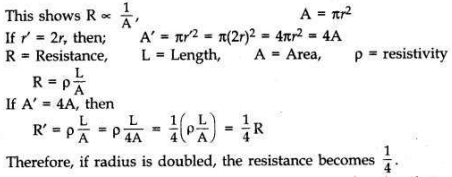
(ii) its radius is doubled?
Answer:
The property of a conductor due to which tends to stop the flow of current through the conductor is called resistance.
SI unit is ohm. When a potential difference of IV across a wire gives
rise to IA current through the wire, then the resistance is said to be 1
ohm (1 Q).
The resistance of conductor depends on length, thickness, nature of material and temperature of conductor.
(i) If length is doubled, then R is doubled because the resistance of a conductor is directly proportional to length.
(ii) Resistance of a conductor is inversely proportional to the square of its diameter or area of cross-section.
Question 19:
Explain why carbon forms compounds mainly by covalent bond. Explain in
brief two main reasons for carbon forming a large number of compounds.
Why does carbon form strong bonds with most other elements?
Answer:

Since,
carbon has 4 electrons in its outermost shell so, it should either lose
or gain 4 electrons to achieve the inert gas configuration and become
stable.
(i) It could gain four electrons forming C
4-
anion. But it would be difficult for the nucleus with six protons to
hold on to ten electrons due to inter electronic repulsion.
(ii) It could lose 4 electrons forming C
4+ cation. But it would require a large amount of energy to remove four electrons from its outermost shell.
Thus, it forms compounds mainly by covalent bonds.
Two properties of carbon which lead to huge number of carbon compounds are:
(i) Catenation. Catenation is the unique property of carbon atoms to
form bonds with other atoms of carbon giving rise to large molecules.
(ii) Tetravalency. Since carbon has a valency of 4, it is capable of
bonding with 4 other atoms of carbon or atoms of some other monovalent
element.
The reason for the formation of strong bonds by the carbon
atoms is their small atomic size. Due to the small size of carbon atoms
their nuclei hold the shared pairs of electrons between atoms strongly,
leading to the formation of strong covalent bonds. The carbon atoms also
form strong covalent bonds with the atoms of other elements such as
hydrogen, oxygen, nitrogen, sulphur, chlorine and other elements.
Question 20:
How many pairs of chromosomes are present in human beings? Out of these
how many are sex chromosomes? How many types of sex chromosomes are
found in human beings? “The sex of a newborn child is a matter of chance
and none of the parents may be considered responsible for it”. Draw a
flow chart showing determination of sex of a newborn to justify this
statement.
Answer:
• There are 23 pairs of chromosomes present in human beings.
• There is 1 pair of sex chromosomes present in human beings.
• The chromosomes which determine the sex of a person are called sex
chromosomes. There are two types of sex chromosomes, one is called X
chromosome and the other is called Y chromosome. Males contain one X
chromosome and one Y chromosome (XY), while females contain two X
chromosomes (XX).
Flow chart showing determination of sex of a child.
(i)
A male has one X-chromosome and one Y-chromosome. Thus half the male
gametes have X-chromosomes and the other half have Y-chromosomes.
(ii) A female has two X-chromosomes. Thus all female gametes have only X- chromosomes.
(iii) If a sperm carrying Y-chromosome fertilises an ovum carrying X- chromosome, then the child born will be a boy.
(iv) If a sperm carrying X-chromosome fertilises an ovum carrying X- chromosome, then the child born will be a girl.
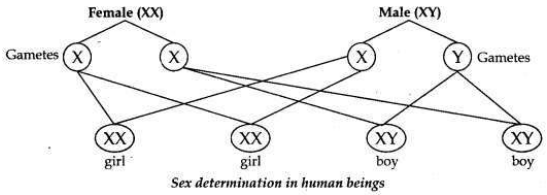
Therefore it is the sperm from the father which determines the sex of the child.
Question 21:
“A convex lens can form a magnified erect as well as magnified inverted
image of an object placed in front of it.” Draw ray diagram to justify
this statement stating the position of the object with respect to the
lens in each case.
An object of height 4 cm is placed at a distance
of 20 cm from a concave lens of focal length 10 cm. Use lens formula to
determine the position of the image formed. 5 Answer:
Answer:
• A
convex lens can form a magnified erect image when the object is placed
between the optical centre and principal focus of the convex lens (i.e.,
between O and F’).
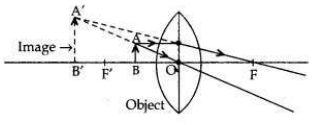
•
A convex lens can form a magnified inverted image when the object is
placed between focus and the centre of curvature (i.e., between F’ and
2F’).
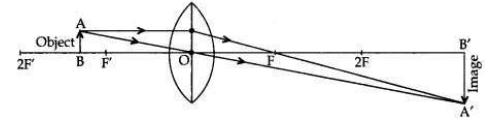
• Object height, n = 4 cm;
Object distance, u = -20 cm Nature of the lens = concave lens; Focal length = f = -10 cm Image distance, v = ?
According to the lens formula,

So, image is formed at 6.66 cm from lens on same side. Image is erect, virtual and diminished in size.
SECTION B
Question 22:
An iron nail is dipped in the solution of copper sulphate for about 30
minutes, state the change in colour observed. Give the reason for the
change.
Answer:
Iron is more reactive than Cu. So it displaces
Cu from copper sulphate solution. Thus, blue colour of the CuS04
solution fades and colour of the solution turns green due to the
formation of ferrous sulphate Solution. This is a displacement reaction.
CuSO
4 (aq) + Fe (s) —> FeSO
4 (aq) + Cu (s)
(Blue) (Green)
Question 23:
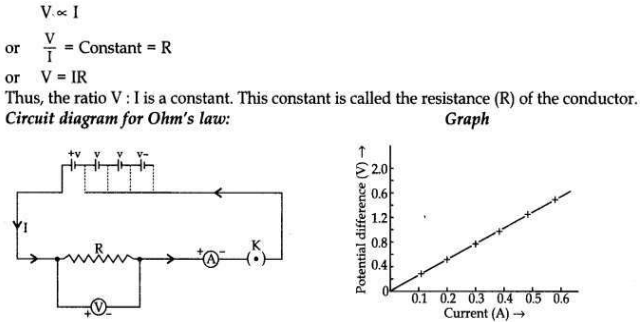
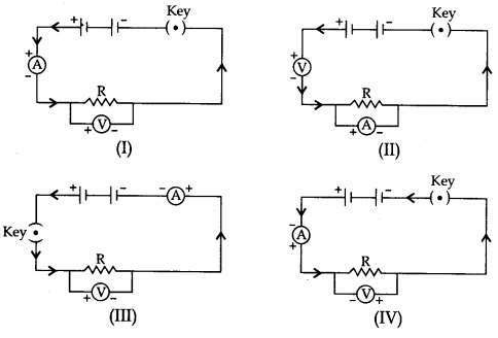
A student while verifying Ohm’s law calculated the value of resistance
of the resistor for each set of observation. However, the values of
resistance were slightly different from the actual value. Is his
experiment wrong? Justify your answer.
Answer:
His experiment is
correct since some of the current is utilized to overcome the
resistance of the wires of the circuit and instruments like ammeter and
voltmeter. Thus the experimental values of resistance were different from the actual value of resistance.
Question 24:
Draw a labelled diagram of stomatal apparatus with closed stomatal pore.
Answer:
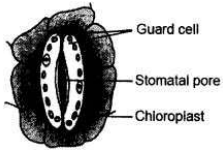
Question 25:
List two observations which you make when you add a pinch of sodium
hydrogen carbonate to acetic acid in a test tube. Write the chemical
equation for the reaction that occurs.
Answer:
When a pinch of sodium hydrogen carbonate is added to acetic acid in a test tube, there are two observations:
(i) Brisk effervescence
(ii) Evolution of a colourless and odourless gas which is CO
2.
CH
3 COOH (aq) + NaHCO
3 (s) -> CH
3 COONa (aq) + H
2O (I) + CO
2 (g) ↑
Question 26:
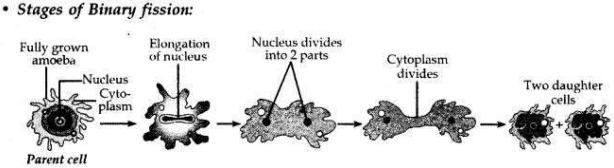
Name the type of asexual reproduction in which two individuals are
formed from a single parent and the parental identity is lost.
Draw the initial and the final stages of this type of reproduction. State the event with which this reproduction starts.
Answer:
• Binary fission is a type of asexual reproduction in which two
individuals are formed from a single parent and the parental identity is
lost.
• This reproduction starts with the elongation of the nucleus.
Question 27:
To find the image-distance for varying object-distances in case of a convex
lens, a student obtains on a screen a sharp image of a bright object
placed very far from the lens. After that he gradually moves the object
towards the lens and each time focuses
(a) In which direction-towards or away from the lens, does he move the screen to focus the object?
(b) What happens to the size of image—does it increase or decrease?
(c) What happen when he moves the object very close to the lens?
Answer:
fa) He moves the screen away from iens to focus the object, l b) The size of the image increases.
Ic) When the object is placed very close to the lens, then no image
will be formed on the screen. As now image formed is erect and virtual.