Class 9 Sample Paper Science 2019

SECTION – A
Question 1:
What do you mean by the word “mole” ?
Answer:
The mole is the amount of substance that contains the same number of particles (atoms/ions/ molecules/formula units, etc.), as there are atoms in exactly 12 g of carbon-12.
Question 2:
What is the ratio of forces between two masses kept at a certain distance in air to the force between them when kept in any other medium ?
Answer:
1 : 1, because the gravitational force is independent of the nature of the medium in which the bodies are placed.
Question 3:
How do bats move about freely even in dark nights and search out prey ? Name the sound waves used by them and write their frequency.
Answer:
Ultrasonic waves emitted by bat are reflected from prey and received by their ears. So they locate obstacles..
Sound wave – Ultrasound, Frequency – Above 20000 Hz.
Question 4:
What is epidermis? List three functions of epidermis.
Answer:
Epidermis is a single layer of cells that covers all the parts of the plant externally
Functions:
(i) Protection: It protects against loss of water, mechanical injury and invasion by parasitic fungi.
(ii) Secretion: Epidermal cells on the aerial parts of the plant often secrete a waxy layer which further helps in protection from mechanical injury and water loss.
(iii) Absorption: Root hairs present on epidermis of root help ip absorption of water and minerals from the soil.
Question 5:
Write the chemical formulae for the following compounds and find the ratio by mass of the combining elements in each one of them. (N = 14 u, H = 1 u, C = 12 u, O = 16 u, S = 32 u)
(a) Methane
(b) Carbon dioxide
(c) Hydrogen sulphide
Answer:
CBSE Sample Papers for Class 9 Science Solved Set 6 5
Question 6:
(a) Do isobars belong to the same element ? Justify your answer by giving one example.
(b) Name two elements whose isotopes are used in the field of medicine.
OR
(a) Mention the steps taken by you or your family members when you fall sick ?
(b) List two ways to treat an infectious disease.
Answer:
(a) No. _{ 6 }^{ 14 }{ C },_{ 7 }^{ 14 }{ N }e.g., are isobars having same atomic mass but different atomic numbers. When atomic number is different it implies that they are different elements.
(b) (i) An isotope of cobalt (CO – 60) is used in the treatment of cancer.
(ii) An isotope of iodine (1 – 131) is used in the treatment of goitre.
OR
(a)
(i) Ensuring proper balanced diet.
(ii) Maintaining personal and public hygiene.
(iii) Isolation from other member if disease is contagious.
(iv) Proper bed rest and avoiding all type of mental stress.
(v) Maintaining healthy surroundings full of congenial (happy) atmosphere.
(vi) Providing vaccination to prevent further damage and supplements of vitamins and minerals to build immunity against future attack.
(b)
(i) To kill the cause of disease by using antibiotics which can kill the disease causing microbes.
(ii) To reduce the effects of the disease by giving treatment which can reduce the symptoms.
e.g., we can take medicines that bring down fever, reduce pain or loose motions.
Question 7:
Complete the following table :
Atomic number
Mass numberNo. neutronNo. of protonsNo. of electrons
Name of the atomic species
–
241212–
–
17–18––
Chlorine
Answer:
Atomic number
Mass numberNo. of neutronNo.of protonsNo. of electrons
Name of the atomic species
12
24121212Magnesium
1735181717
Chlorine
Question 8:
Explain the following terms in brief:
(a) Bilaterally symmetrical
(b) Triploblastic
(c) Coelom
OR
Differentiate between the following (any one point):
(a) Diploblastic and Triploblastic
(b) Monocots and Dicots
(c) Warm blooded and Cold blooded animals Answer:
(a) It means that, the left and the right halves of the body have the same design.
(b) The animals whose body tissues are derived from three layers of cells are called triploblastic.
(c) The true, internal body cavity in which well developed body organs can be accomodated is called coelom.
OR
(a)
Diploblastic
Triploblastic
The body is made of two layers of cells (ectoderm and endoderm).
e.g., Hydra, Jelly fish and Sea anemone.
The body is made of three layers of cells (ectoderm, endoderm and mesoderm).
e.g., Platyhelminthes, Nematoda and all higher phylums.
(b)
Monocots
Dicots
(i)They have only one cotyledon in the seeds,
(i) They have two cotyledons in the seeds,
(ii) The flower of monocots is (rimerous (multiple of three) and leaf shows parallel venation.
e.gv Grass, wheat, maize, rice, etc
(ii) The flower of dicots in pentamerous (multiple of 5) and leaf shows reticulate venation.
e.g., Pea, pulses, mustard, etc.
(c)
Warm blooded animals
Cold blooded animals
(i) Their body temperature remains constant irrespective of their surroundings.
(i) Their body temperature changes according to the temperature of the surroundings.
(ii) They are also known as homeothermals and have energy requirements.
e.gv Aves and mammals.
(ii) They are also known as poikilothermals and have low energy requirements,
e.g., Pisces, amphibians and reptiles.
Question 9:
Area of bottom of a boat is 6 m2 it is floating on water. The boat sinks by is 1 cm, when a man gets on it. What is the mass of the man ?
Answer:
A = 6 cm2
Floating of water
Weight of boat = Buoyant force
mg = vdg; m = vd = 0.06 × 1000 = 60 kg [ v = A × Depth = 6 × 0.01 – 0.06 m3]
Question 10:
(a) A horse exerts a pull on a cart of 300 N. This makes the horse – cart system move with a uniform speed of 18 km h’1 on a level road. Calculate the power developed by the horse in watt.
(b) Prove that the total energy at any point in the path of a dropped mass is ’mg’ times the height from where it is dropped.
Answer:
CBSE Sample Papers for Class 9 Science Solved Set 6 10
Question 11:
(a) What do you mean by a pure substance ? Give an example.
(b) Name the appropriate methods to separate the following :
(i) Nitrogen from air
(ii) Dye from blue ink
(iii) Butter cream from milk
(iv) Ammonium chloride from common salt.
Answer:
(a) Pure substance : A pure substance contains only one kind of atoms or molecules and is homogeneous throughout its mass. A pure substance has a fixed composition as well as a fixed melting and boiling point, e.g., iron, water, etc.
(b)
(i) Fractional distillation
(ii) Chromatography
(iii) Centrifugation
(iv) Sublimation
Question 12:
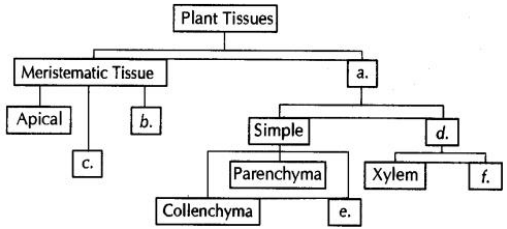
Complete the following flow diagram:
CBSE Sample Papers for Class 9 Science Solved Set 6 12
Answer:
(a) Permanent tissue
(b) Lateral meristem
(c) Intercalary meristem
(d) Complex permanent tissues
(e) Sclerenchyma
(f) Phloem
Question 13:
Derive following equations for a uniformly accelerated motion :
(i) v = u + at (ii) S = ut + l/2at2, where symbols have their usual meaning.
Answer:
Suppose, the initial velocity of a body is u and it is moving with uniform acceleration a for time t. Let the final velocity be v and the distance covered be S. Then, we have .
CBSE Sample Papers for Class 9 Science Solved Set 6 13
Question 14:
Neem and turmeric powders are often used in grain storage.
(i) What are they called?
(ii) What is the purpose of using neem and turmeric?
(iii) What are herbicides?
Answer:
(i) Bio-pesticide.
(ii) Neem and turmeric keep away insects, rodents, fungi, mites, bacteria etc. from the stored foods.
(iii) Herbicides are chemicals used for removal of weeds from cultivated fields during the early
stages of crop growth.
Question 15:
Shruti went to a hill station with her parents and her elder brother Rushil. One day they were walking through a valley where Shruti and her brother started playing. Shruti was surprised to distinctly hear the same sound twice. She discussed it with her brother. He told her that this phenomenon is called ’echo’.
(a) Define echo. What should be the minimum distance from the source for a distinct echo to be heard
(b) Write the values shown by Rushil?
Answer:
(a) Echo: It is the phenomenon of reflection of sound of a source from an obstacle. Minimum distance – 17.2 m
(b) Values shown by Rushil are – ready to listen to scientific facts, good listener.
Question 16:
(a) Give reason for the following :
(i) Why does a desert cooler cool better on a hot dry day ?
(ii) Why do we prefer to wear cotton clothes during summer ?
(b) Write any three differences between evaporation and boiling.
Answer:
(i) The humidity, i.e., the amount of water vapour in air is less on a hot dry day. Lesser the humidity, more is the rate of evaporation. Since the rate of evaporation is more on a hot dry day, a desert cooler cools better.
(ii) We perspire more during summer. Cotton is a good absorber of water. It absorbs sweat and exposes it for easy evaporation. As a result body feels cool and comfortable. So, we should wear cotton clothes during summer.
(b)
Boiling
Evaporation
(i) Boiling is a bulk phenomenon,
(i) Evaporation is a surface phenomenon.
(ii) Particles from the bulk of the liquid change into vapour state.
(ii) Particles from the surface gain enough energy to overcome the jntermolecular forces of attraction present in the liquid and change into the vapour state.
(iii) Boiling starts at boiling point of a substance.
(iii) Evaporation starts below the boiling point.
Question 17:
(i) Identify in the situations given below where the object is making a uniform circular motion:
(a) A car turning around a curve with uniform speed. A car going uphill.
(b) Motion given to a discus by an athlete before releasing it. Motion of discus when the athlete releases it.
Give reason for your answer.
(ii) A cyclist completes five rounds of a circular track of radius 21 m in 12 minutes. Calculate his speed.
(iii) An artificial satellite moves around the earth with a velocity of constant magnitude, still its motion is said to be an accelerated motion, why ?
Answer:
CBSE Sample Papers for Class 9 Science Solved Set 6 17
(iii) Satellite is moving in a circular orbit with constant magnitude of velocity but its direction of motion is changing continuously, therefore, its motion is accelerated as the velocity changes in direction.
Question 18:
(a) How layers are different from broilers ? Give at least three differences between the two.
(b) What is composite fish culture system ? State one merit and one demerit of such a system.
Answer:
(a)
Layers
Broilers
(i) Layers are egg-laying chickens, managed for the purpose of getti ng eggs.
(ii) Layers start producing eggs at an age of 20 weeks. So, they are kept for longer period depending upon laying period (approx. 500 days).
(iii) They require enough space and adequate lighting.
(i) Broilers are maintained for getting meat.
(ii) They are raised up to 6-7 weeks in poultry farms and then sent to market for meat purposes.
(iii) They require conditions to grow fast and low mortality,
(b) A combination of five or six species raised in a single fishpond is called composite fish culture. Merit: The fishes raised have different food habits. So, these do not compete with each other for food. This increases fish yield.
Demerit: Many of these fishes breed only during monsoon.
Question 19:
(a) Name the international organization who approves names of elements.
(b) Give an example with explanation to show that the Law of conservation of mass applies to physical changes also.
Answer:
(a) IUPAC (International Union of Pure and Applied Chemistry).
(b) Law of conservation of mass states that “mass can neither be created nor destroyed in a – chemical reaction.”
This law applies to physical changes also.
e.g., During interconversion of water into three states of matter there is no change in the mass of water taken although there is change in the three states.
CBSE Sample Papers for Class 9 Science Solved Set 6 19
Question 20:
Give reasons:
(a) Animals of phylum platyhelminthes are called flatworms.
(b) Bryophytes are called amphibians of the plant kingdom.
(c) Fungi are called saprophytes.
(d) Bacteria and tapeworms are very different in their body design.
(e) Plants like Pinus and Deodar are called gymnosperms.
Answer:
(a) Because they show such body design which is dorsiventrally flattened.
(b) Because they can live both on land and in water but they require water for fertilization as their gametes are non-motile.
(c) Because they use decaying organic material as food.
(d) Because bacterial belongs to kingdom monera and these organisms do not have a defined nucleus or organelles whereas tapeworm belongs to phylum platyhelminthes whose body is triplastic, bilaterally symmetrical, complex with true internal body cavity called coelom.
(e) Because they bear naked seeds and are usually perennial, evergreen and woody which are the features of gymnosperms.
Question 21:
(a) State Archimedes’ principle.
(b) It is easier to swim in sea water than in river water. Why ?
(c) Give any two important applications of Archimedes’ principle.
(d) What do you mean by relative density of a substance? What is its unit ?
OR
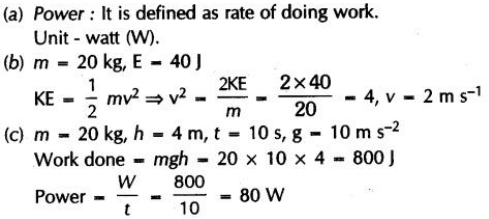
(a) Define power. Give its unit.
(b) A moving body of mass 20 kg has 40 Joules of kinetic energy. Calculate its speed.
(c) A person carrying a load of 20 kg climbs 4 m in 10 seconds. Calculate the work done and his power, (g = 10 m s-2)
Answer:
(a) Archimedes’ principle : When an object fully or partially immersed in a fluid, it experiences an upward thrust which is equal to the weight of fluid displaced by it.
(b) Because of higher density.
(c) 1. To check the purity of sample of milk.
2. To find the density of liquid.
(d) Relative density : It is the ratio of density of substance to the density of water. Units – It has no units
OR
CBSE Sample Papers for Class 9 Science Solved Set 6 21
SECTION – B
Question 22:
(a) Mention the type of thermometer that should be used to determine the melting point of ice
in laboratory.
(b) While doing an experiment to determine the melting point of ice, state the role of glass stirrer.
Answer:
(a) Laboratory thermometer with minimum range of -10°C.
(b) Glass stirrer is used to mix the ice and ice cold water thoroughly to get a uniform temperature.
Question 23:
A substance ‘X’ was taken and was added to distilled water. On stirring thoroughly the aqueous solution was left to stand for sometime. It was observed that its particles began to settle at the bottom. By this information what do you infer about the solution? What would happen if a beam of light is passed through this solution ? Answer:
(i) The given solution is a suspension.
(ii) Light does not pass through and no Tyndall effect is observed.
Question 24:
List two precautions to be taken while you determine the mass percentage of water imbibed by raisins.
Answer:
(i) Only clean raisins should be used for the experiment.
(ii) Petri dish should be left undisturbed.
Question 25:
In a spring balance the space between 0 to 25 g wt is divided into 5 equal parts. Find its least count. What is the weight of the object in the diagram given below ?
Answer:
CBSE Sample Papers for Class 9 Science Solved Set 6 25
Question 26:
An object of volume 25mL suffers a loss in weight of 15 gwt when immersed fully in a solution. Find the density of the solution.
Answer:
Question 27:
(a) Why the body of bony fish is streamlined 1
(b) List two habitats of bony fish.
Answer:
(a) To reduce friction while swimming. It means that it offer least resistance to motion while swimming.
(b)
(i) Ponds
(ii) Lakes
(iii) Rivers
It’s habitat includes shallow water, having less salt concentration (known as fresh water) and higher levels of dissolved oxygen.
We hope the Solved CBSE Sample Papers for Class 9 Science Set 6, help you. If you have any query regarding CBSE Sample Papers for Class 9 Science Solved Set 6, drop a comment below and we will get back to you at the earliest

CBSE Class 9 Sample paper Science 2019

SECTION – A
Question 1:
List the combining elements in Ammonia
Answer:

CBSE Sample Papers for Class 9 Science Solved Set 5 1
Question 2:
State the universal law of gravitation.

CBSE Class 9 Science Sample paper 2019 Download

SECTION – A
Question 1:
Give a relation correlating sound velocity with its frequency and wave-length. Answer:
Velocity of sound (υ) = frequency (ν) x wavelength (λ).
Question 2:
Suggest separation techniques one would need to employ to separate the following mixtures:
(a) Mercury and water
(b) Potassium Chloride and ammonium chloride.
Answer:
(a) Using separating funnel.
(b) Using sublimation.

Solve Class 9 Science CBSE Sample paper 2019

SECTION – A
Question 1:
Write the units of ‘g’ and ‘G’.
Answer:
SI unit of ‘g’ is m s-2 and that of ‘G’ is N m2 kg-2.
Question 2:
J. Chadwick discovered a subatomic particle which has no charge and has mass nearly equal to that of a proton. Name the particle and give its location in the atom. Answer:
The particle is called neutron. It is located in the nucleus of the atom.
Question 3:
You are provided with a fine white coloured powder which is either sugar or salt. How will you identify it without tasting ?
Answer:
Salt is NaCI which is an ionic compound. Its solution reacts with a solution of silver nitrate (AgNO3) which is also ionic in nature, to give a precipitate of silver chloride. On the other hand, sugar is not ionic in nature and does not give this type of reaction. So, if we obtain a white precipitate on adding silver nitrate solution to the solution of the given substance, it is salt otherwise it is sugar.
Question 4:
Why do some children fall ill more frequently than others living in the same locality ? Answer:
Children living in same locality implies that they are exposed to same surroundings. However, some fall ill more frequently. This could be because they may be under-nourished which may result in poor immunity and hence their catching infections more easily.
Also personal hygiene, genetic make up etc., play a vital role.
Question 5:
“Every multicellular organism has arisen from a single cell.” Justify this statement.
Answer:
Multicellular organisms are higher organisms and usually undergo sexual reproduction in which there is fusion of gametes from two parents involved. This is called fertilisation and results in formation of a single cell called zygote which undergoes cell division and differentiation to form a multicellular organism.
Question 6:
(a) A person moves a distance of 3 km towards east, then 2 km towards north and then 3.5 km towards east. Find :
(i) the distance covered by the person,
(ii) the displacement of this motion.
(b) Name the type of motion in which a body has uniform speed but not uniform velocity ?
Answer:
(a) Distances of AB = 3 km east, BC = 2 km north and CD = 3.5 km east are shown in figure.
CBSE Sample Papers for Class 9 Science Solved Set 3 6
(b) Uniform circular motion.
Question 7:
(a) A block of mass m raised from position A to 6 by taking two different paths as shown in figure (a) and (b). Let the height AB = h. Now answer the following questions:
(i) What is the work done on the block in figure (a) and (6)?
(ii) Name the energy possessed by the block at position B in both the cases. A
(b) Find the potential energy possessed by an object of mass 6 kg when it is at a height of 15 m above the ground.
(Take g = 9.8 m s-2)
CBSE Sample Papers for Class 9 Science Solved Set 3 7
Answer:
(a) (i) Work done on the block in both cases is W = mgh.
(ii) At position B the block possesses gravitational potential energy Ep = mgh.
(b) Here mass m = 6 kq, heiqht h = 15 m and q = 9.8 m s-2 Potential enerqy of object
Ep = mgh = 6 x 9.8 x 15 = 882 J
Question 8:
(a) A cork piece floats on water but an iron nail sinks in water. Why ?
(b) What is the difference between density of a substance and its relative density ? Write SI unit of both.
Answer:
(a) A cork piece floats on water because its density is less than the density of water. On the other hand, an iron nail sinks because density of iron nail is greater than the density of water.
(b)
Density
Relative density
(1) The density of a substance is defined as its mass per unit volume,
(2) The SI unit of density is kg/m³.
(1) Relative density of a substance is the ratio of its density to the density of water,
(2) Relative density is a unitless quantity.
OR
Two objects of masses mi and m2, when separated by a distance d, exerts a force F on each other. What happens when
(i) value of mass of first object is doubled ?
(ii) masses of both objects are doubled ?
(iii) masses are brought closer so that distance between them becomes d/2 ?
(iv) the space between the two objects has no air and it is complete vacuum ?
Answer:
CBSE Sample Papers for Class 9 Science Solved Set 3 8
Question 9:
(a) What do the graphs of figure indicate ?
CBSE Sample Papers for Class 9 Science Solved Set 3 9Q
(b) On a 120 km track a train travels the first 30 km at a uniform speed of 30 km hr1. Calculate the speed with which the train should move rest of the track so as to get the average speed of 60 km hr1 for the entire trip.
Answer:
(a) Graph of figure
(i) indicates uniformly retarded motion but graph of figure
(ii) shows non-uniformly accelerated motion.
CBSE Sample Papers for Class 9 Science Solved Set 3 9
Question 10:
State any four postulates of Dalton’s atomic theory of matter. Which of his postulates does not hold correct at present ?
Answer:
The postulates of Dalton’s atomic theory of matter are :
(i) All matter is made of very tiny particles called atom.
(ii) Atoms of a given element are identical in mass and chemical properties.
(iii) Atoms of different elements have different masses and chemical properties.
(iv) Atoms combine in the ratio of simple whole numbers to form compounds.
(v) Atoms are indivisible particles which cannot be created or destroyed in a chemical reaction.
The postulate that atoms are indivisible particles does not hold good at present. We know that an atom is made up of protons, neutrons and electrons.
Question 11:
Write the electronic configuration and valency of the following:
(i) Chlorine
(ii) Sodium and
(iii) Silicon
Answer:
CBSE Sample Papers for Class 9 Science Solved Set 3 11
OR
(a) Both helium and beryllium have Helium is a noble gas whereas Beryllium is a metal, justify.
(b) Hydrogen exists in three isotopic forms. Why are the isotopes of hydrogen chemically alike ?
Answer:
(a) Maximum capacity of the first orbit is 2 electrons. Therefore, helium having two electrons in the valence shell is stable and hence has no tendency to react.
Beryllium has two shells K and L. The maximum capacity of the L-shell is 8 whereas beryllium has only 2 electrons in the L-shell. It will therefore react with other beryllium atoms to form Be-Be bonds. It is therefore a metal.
(b) The three isotopes of hydrogen are ¹H1, ²H1 and ³H1. The chemical property of an element depends upon the number of protons. Since the number of protons in the isotopes is the same, the isotopes are chemically alike.
Question 12:
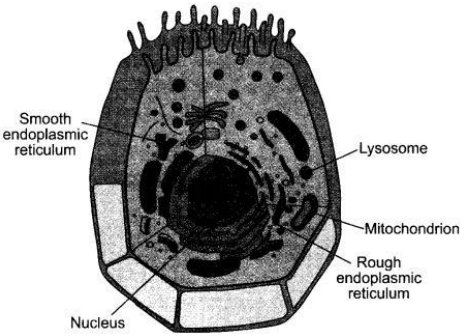
Draw the diagram of an animal cell and label the following :
(i) Factory of ribsomes.
(ii) Power house of cells.
(iii) Waste disposal system of the cell.
(iv) Director/brain/control centre of the cell.
Answer:
(i) Endoplasmic Reticulum
(ii) Mitochondria
(iii) Lysosomes
CBSE Sample Papers for Class 9 Science Solved Set 3 12
Question 13:
How are phanerogams classified ?
Answer:
Phanerogams are seed producing/flowering plants. They are classified as :
CBSE Sample Papers for Class 9 Science Solved Set 3 13
(i) The seeds of gymnosperms are naked whereas angiosperms bear seeds inside the fruits.
(ii) The sporophylls in gymnosperms are aggregated to form cones. On the other hand sporophylls in angiosperms are aggregated to form flowers.
Question 14:
(a) Name any one disease caused by bacteria and virus.
(b) Why are antibiotics effective against bacteria but not viruses ?
Answer:
(a) Disease caused by –
(i) Bacteria – Tuberculosis
(ii) Virus – AIDS (Acquired Immuno-Deficiency Syndrome)
(b) Antibiotics act by preventing one of the bio-chemical events towards formation of a new pathogen cell. Thus, most prevent cell wall formation, which happens in bacterial cell only, thereby preventing bacterial diseases.
Question 15:
Rameshwar took the responsibility of his fields when his father got old. His father advised him to use farmyard manure over fertilisers but he wanted to use chemical fertilisers. His father told him about the adverse effects of chemical fertilisers to the nearby water bodies.
Rameshwar’s father encouraged him as his friends also use organic manure and careful and judicious use of chemical fertilisers.
(i) Why should chemical fertilisers be used carefully and judiciously ?
(ii) Manures are natural fertilisers. How can they be prepared in the Held ?
(iii) Why did Rameshwar’s father advise him ?
Answer:
(i) Fertilisers should be applied carefully in terms of proper dose, time and observe pre and post application precautions for their complete utilisation. Continuous use of fertilisers in an area can destroy soil fertility because organic matter in the soil is not replenished and micro-organisms in the soil are harmed. Excess use of fertilisers can also lead to water pollution.
(ii) Manure is prepared by the decomposition of plant waste and animal excreta (cowdung). It helps in enriching soil with nutrients and organic matter. It improves the soil structure, increases water-holding capacity and avoids water logging. Based on kind of biological material used, manure can be broadly classified into compost or vermicompost and green manure.
(iii) Rameshwar’s father advised him so as he was concerned about the environment. He cares about other living beings and is a conscientious human being.
Question 16:
(a) Give three medical uses of ultrasound.
(b) A ship which is stationary is at a distance of 2800 m from the sea bed. This ship sends an ultrasound singal to the seabed and its echo is heard after 4 s. Find the speed of sound in water.
Answer:
(a) Important uses of ultrasound in medical field are as follows :
(i) In a ultrasound scanner the ultrasonic waves are used for getting images of internal organs of the body such as liver, gall bladder, kidney, uterus etc. The technique is known as ultra sonography.
(ii) Echo cardiography is a medical diagnostic technique in which ultrasonic waves are used to construct the image of heart.
(iii) Powerful ultrasounds are used for treatment of kidney stones.
(b) Distance of ship from seabed d = 2800 m, time of echo t = 4 s. If speed of sound in water be v, then
CBSE Sample Papers for Class 9 Science Solved Set 3 16
Question 17:
Two objects A andfi, having masses 100 kg and 75 kg, moving with velocities 40 km/h and 60 km/h respectively. Answer the following :
(a) Which will have greater inertia ?
(b) Which will have greater momentum ?
(c) Which will stop first if equal negative acceleration is applied on both ?
(d) Which will travel greater distance in 10 minutes ?
(e) Which will impart greater force if collided with a wall ?
Answer:
CBSE Sample Papers for Class 9 Science Solved Set 3 17
’a’, SA may be less than or greater than SB.
(e) The force imparted on collision with a ball is equal to rate of change of momentum of the given object. As a result, object B will impart a greater force.
Question 18:
(i) Account for the following :
(a) The temperature of water remains constant during boiling.
(b) Evaporation is a surface phenomenon.
(c) The shape between the constituent particles is maximum in gases.
(ii) Suppose you want to convert a gas into a liquid, which two methods can you apply ?
Answer:
(i) (a) After water has started boiling, the heat supplied is used to increase the kinetic energy of the particles to convert into gaseous state. Therefore the temperature does not rise.
(b) Particles on the surface absorb energy from the surrounding and escape. Therefore
evaporation is a surface phenomenon.
(c) Particles in a gas have maximum kinetic energy. They are moving freely in all directions and thus space between particles is maximum in gases.
(ii) (a) by increasing pressure.
(b) by lowering the temperature.
Question 19:
Describe any three properties of colloids. Categorise the following examples of colloids into different categories of colloids : jelly, fog, milk, shaving cream.
Answer:
Properties of colloids :
(i) The size of particles of a colloid is too small to be seen individually by naked eyes.
(ii) Colloids are big enough to scatter a beam of light passing through it and makes its path visible.
(iii) They do not settle down when left undisturbed, that is, a colloid is quite stable.
CBSE Sample Papers for Class 9 Science Solved Set 3 19
Question 20:
Describe the oxygen-cycle in nature.
Answer:
Oxygen-cycle : Oxygen from the atmosphere is used up in combustion, respiration and in the formation of oxides of nitrogen. It is returned to the atmosphere through photosynthesis.
CBSE Sample Papers for Class 9 Science Solved Set 3 20
Question 21:
(a) Give two characteristics of the following phylum :
(i) Platyhelminthes
(ii) Arthropoda
(iii) Porifera.
(b) What is notochord and explain its function ?
Answer:
(a) (i) Platyhelminthes – A phylum of flatworms where the body is dorsoventrally flattened, triploblastic but acoelomate with organ level of organization and bilateral symmetry. They possess soft, elongated leaf like or tape like body which exhibits bilateral symmetry.
(ii) Arthropoda – A phylum of triploblastic, bilaterally symmetrical segmented animals having jointed legs and appendages a chitinous exoskeleton and a blood filled body
cavity called haemocoel. It is the largest group of animals, which are found in variety of habitats like land, moist soil, fresh water, marine water as well as on the bodies of other animals.
(iii) Porifera – Porifera is a phylum of diploblastic, acoelomate animals having cellular level organisation, porous body with canal system and sedentary habit. The body has a covering of hard skeleton which comprises of spicules of calcium carbonate, silica or spongin fibres.
(b) A notochord is a solid rod present in chordates at some stage.
It provides place for muscles to attach. It increases internal support and locomotory power.
OR
(a) List three characteristic features of kingdom Monera.
(b) Write two examples each :
(i) Egg laying mammals
(ii) Organisms with open circulatory system
Answer:
(a) The identifying features of kingdom Monera are as follows :
(i) They are prokaryotes. Membrane bound cell organelles are absent. They have naked genetic material called nucleoid.
(ii) Monerans are basically unicellular. In filaments and colonies the cells are similar and independent.
(iii) Both autotrophic and heterotrophic mode of nutrition are found.
(iv) This kingdom includes bacteria, blue green algae or cyanobacteria and mycoplasma.
(v) Some representatives of this kingdom have a cell wall and some do not have it.
(b) (i) Egg laying mammals – Echidna, Duck billed platypus
(ii) Organisms with open circulatory system – Phylum Arthropoda and Mollusca.
SECTION – B
Question 22:
State the factors on which buoyant force acting on an object immersed in a fluid depend.
Answer:
The magnitude of buoyant force acting on an object immersed in a fluid depends on
(a) the volume of the immersed part of the object, (b) the density of the fluid, and (c) the value of acceleration due to gravity at the given place.
Question 23:
How is experiment of reflection of sound different from the experiment on laws of reflection of light ?
Answer:
For reflection of light we require a polished mirror as the reflecting surface and mark pins to know the direction of incident and reflected rays.
However, for reflection of sound we require a large sized, smooth and hard wooden/metal sheet/wall as the reflecting surface and two long identical plastic pipes of small diameter for passage of incident and reflected sound.
Question 24:
Which portion of temperature-time graph showing heating of ice at – 10 °C to water at 100 °C represent the change of state on heating ?
CBSE Sample Papers for Class 9 Science Solved Set 3 24
Answer:
The portion BC represents the heating of ice at 0 °C to water at 0 °C and the portion BE represents of heating of water at 0 °C to 100 °C.
Question 25:
An experiment is being carried out as shown in the figure. Mass of the conical flask with the contents as shown was taken. The flask was shaken so as to allow a reaction between the contents of the ignition tube and the flask. After allowing to come to room temperature, mass of the flask with its contents was taken.
(a) Do you find any difference between the mass before and after shaking ?
(b) Which law of science does this experiment prove ?
CBSE Sample Papers for Class 9 Science Solved Set 3 25
Answer:
(a) There is no difference in the mass of the flask before and after shaking.
(b) This experiment proves the law of conservation of mass.
Question 26:
Define venation. Give two types of venation alongwith suitable example.
Answer:
Venation is defined as arrangement of veins (vascular bundles) in the leaves.
It is of two types :
(i) Reticulate – where veins form a network, e.g., mango, peepal tree.
(ii) Parallel – where veins run parallel to each other, e.g., grasses, rice, wheat etc.
Question 27:
Name the phyla to which following organisms belong. Arrange in ascending order of complexity of body design and give a common feature. Moss, Fern, Mucor, Spirogyra
Answer:
Moss – Phylum Bryophyta
Fern – Phylum Pteridophyta
Mucor – Phylum Fungi
Spirogyra – Phylum Thallophyta
Ascending order of complexity of body design :
Mucor —> Spirogyra -» Moss —> Fern
Common feature – All these possess cell wall

Solved CBSE Class 9 Science Sample paper 2019

SECTION – A
Question 1:
A ball is thrown vertically upwards. What is its momentum at the highest point ?
Answer:
Zero because velocity of ball is zero at the highest point of its motion.

CBSE Class 9 Science Sample paper 2019

SECTION – A
Question 1:
If on a round trip you travel 6 km and then arrive back home, calculate your displacement after completing the trip.
Answer:
Displacement is zero.
Question 2:
The atomic number of three elements A, B and C are 9,10 and 13 respectively. Which of them will form a cation ?

Answer:
The element with atomic number 13 will form a cation. It has the electronic configuration 2, 8, 3. It loses three electrons to attain stable octet and forms the cation.

Magnetic Effects of Electric Current Class X

1. List the properties of magnetic lines of force.
Ans. Properties of magnetic field lines of force as follows:
a. Outside a magnet, the field lines are directed from N-pole of magnet towards S-pole and inside the magnet lines are directed form S-pole to N-pole.
b. Magnetic field lines are closed curves.
c. No two magnetic field lines intersect each other’s.
d. Relative strength of magnetic field lines is given by degree of closeness of the filed lines